On the move. Taking research between islands.
Topic tag: Field Notes
Read time: 4 min read
On This Page
Key takeaways
Reordering at your destination is usually simpler than carrying vials. The one strong reason to carry is batch continuity.
If you do carry, move unopened vials only, sealed in their packaging and with their batch tags.
Heat builds in parked cars, at ports and on ferry car decks. Keep the trip short and out of the sun.
Put vials in a freezer as soon as you arrive, then log the move.
1. Carry or reorder
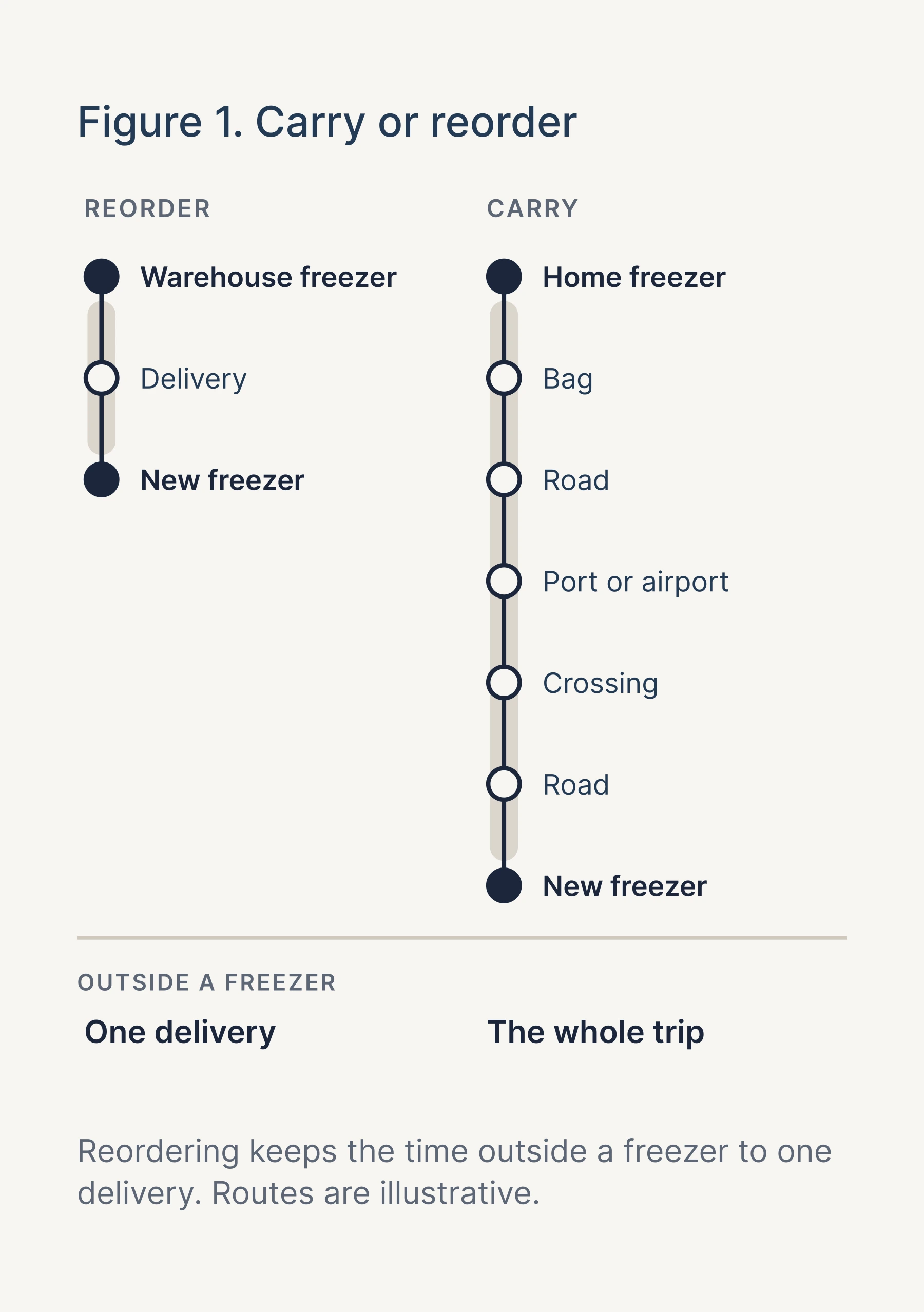
Moving between islands partway through a project raises a simple question: take the vials with you, or order fresh at the other end?
Within Indonesia, reordering is usually the simpler choice. Material that stays in your freezer at home stays at a steady temperature, and the new order arrives with its own batch record.
There is one strong reason to carry: batch continuity. If a run needs the same batch from start to finish, the vials you already have may be the only ones left from that batch. If you are moving for good, carrying may also be the only option. The rest of this guide covers doing it well.
2. Move unopened vials only
Freeze-dried powder in a sealed vial handles room temperature well, as our In transit article explains. That tolerance is a margin, and a trip spends part of it.
Opened material has less margin to spend. Where you can, finish or leave opened vials before the move, and take only sealed ones.
Keep each vial in its original box with its batch tag. A vial without its batch number is a vial you can no longer match to its lab results.
3. Where heat builds
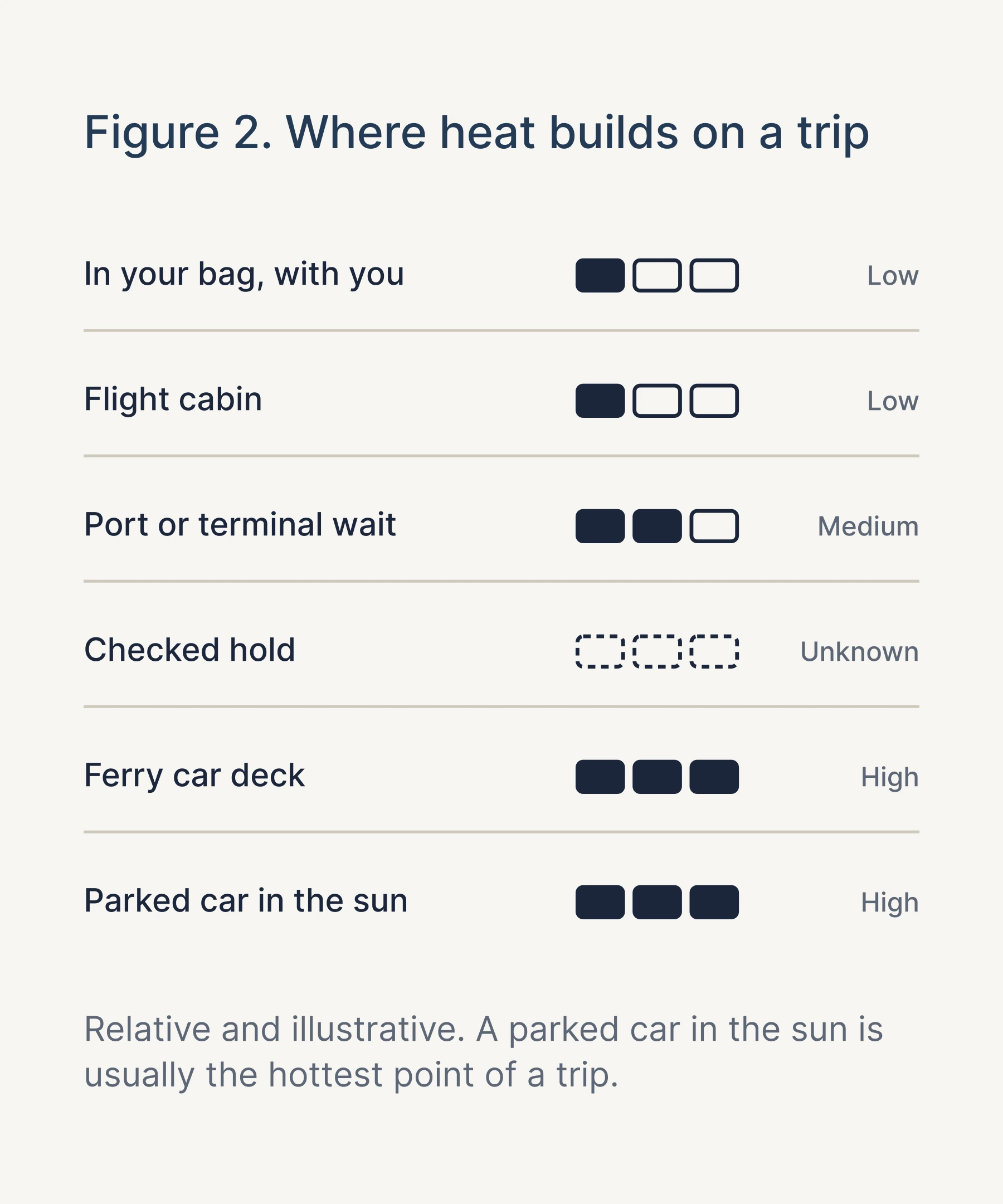
Most of a trip is not the problem. A few points are:
- A parked car. Vehicles heat up fast in the sun. Our Distance article covers a study where delivery van cargo spaces passed 50°C with only 23°C outside.
- Ports and terminals. Waiting for a ferry often means an hour or more in the open.
- Ferry car decks. Enclosed, full of engines and rarely cooled.
- Checked luggage. You cannot see where it waits. Keep vials with you where the airline’s rules allow it.
The hottest part of most trips is not the crossing. It is the hour the car sits parked.
4. Pack simply
Keep vials upright in their box, padded against knocks. An opaque pouch keeps out light, which is one of the slower ways peptides degrade.
Write down what you are carrying before you leave: compound, batch number and number of vials. It takes two minutes and makes the log easy later.
5. On arrival
Freezer first, before unpacking anything else. Unopened vials go back to frozen storage right away.
When you later open a vial, let it reach room temperature while still sealed, as our After receipt guide explains. Cold glass in tropical air collects condensation quickly.
Then log the move: the dates, the route, roughly how long the vials were out of a freezer, and anything unusual, such as a delay at the port.
6. Check before you continue
If the trip went to plan, carry on. If it ran long or the vials sat somewhere hot, note it and treat that material with caution.
Heat damage does not usually show on freeze-dried powder. A vial that looks normal can still have changed. When in doubt, ask before you continue.
How OPtide helps when you move
- Two warehouses: stock is held in Bali and Jakarta, and each order ships from the nearer one.
- Delivery across Indonesia: in the main cities, orders arrive by instant or next-day delivery.
- Batch records: every batch has its own verification page, so a new order comes with its lab results.
- A person to ask: questions about stock or batches go to a real person on WhatsApp or by email.
A note on research use
OPtide compounds are supplied for laboratory research only. They are not for human consumption.
New island. Same standards.
Order at your destination, and it ships from the nearer of our Bali and Jakarta warehouses.