Distance. Why ship-from location matters in the tropics.
Topic tag: Sourcing & Supply
Read time: 4 min read
On This Page
Key takeaways
Freeze-dried peptides handle room temperature, but that tolerance is a margin, not a guarantee.
Heat uses up the margin faster, and a parked delivery van gets far hotter than the air outside.
Distance adds days, handovers and sometimes customs. Each one is another chance for heat.
Local stock shortens the trip to hours, which leaves almost all of the margin intact.
1. A margin, not a guarantee
Our article on transit explains why freeze-dried powder travels well. With the water removed and the vial sealed, degradation slows to a crawl. In good packaging, that margin is measured in weeks.
That figure assumes a moderate room temperature. Real trips are rarely moderate.
So the useful question is not whether the powder survives the trip. It is how much of its margin the trip spends.
2. Heat uses it up faster
Chemical reactions speed up as temperature rises. A common rule of thumb in chemistry is that many reactions roughly double in speed for every 10°C rise. Degradation in a vial follows the same pattern.
This means hot hours count for more than cool ones. A day at 40°C is not the same as a day at 25°C.
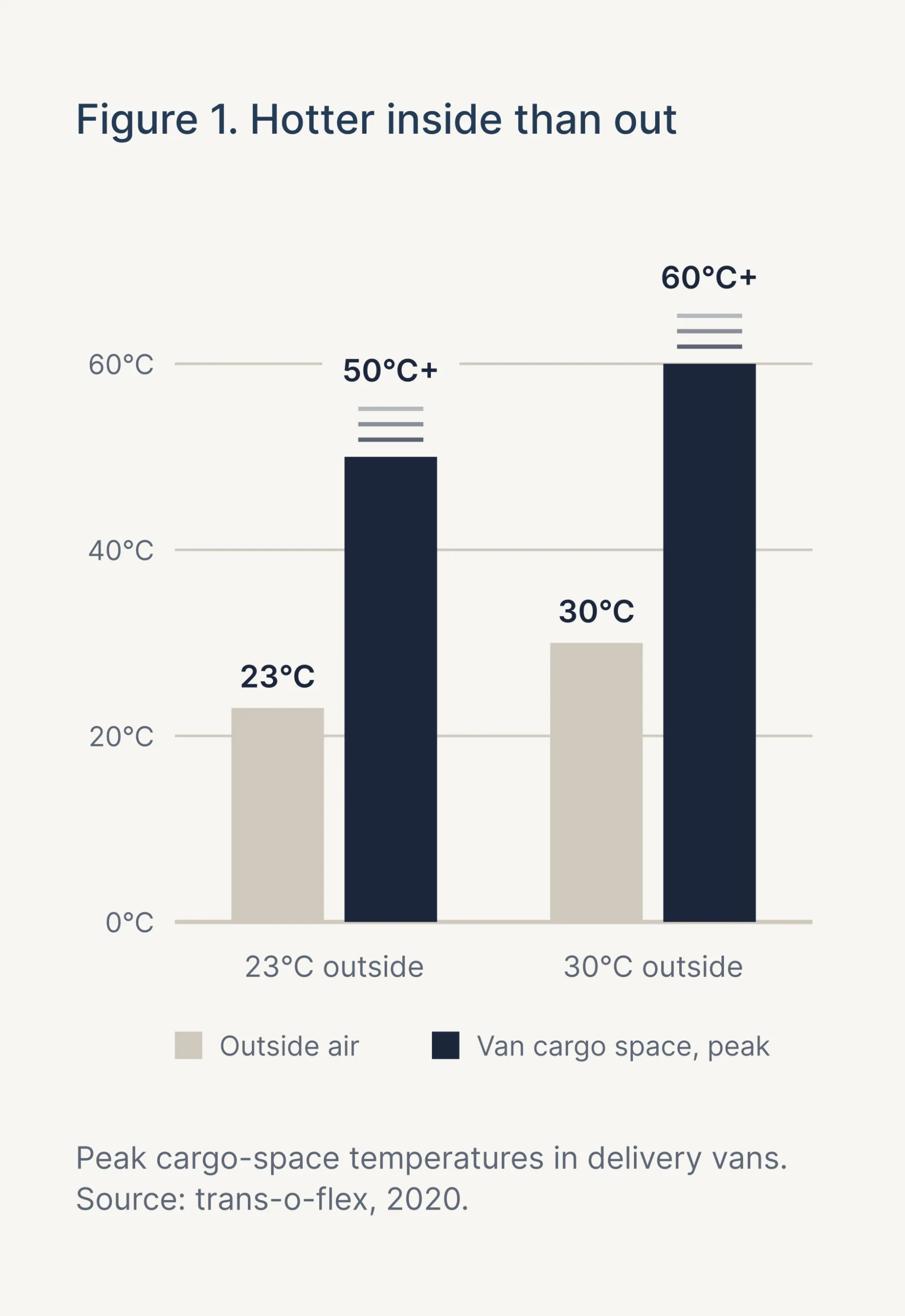
In Bali and Jakarta, daytime air sits around 30°C for most of the year. Inside a vehicle it climbs much higher. A 2020 study by the German logistics company trans-o-flex measured the cargo space of its delivery vans. With 23°C outside, peaks passed 50°C. With 30°C outside, peaks passed 60°C.
3. Distance multiplies the exposure
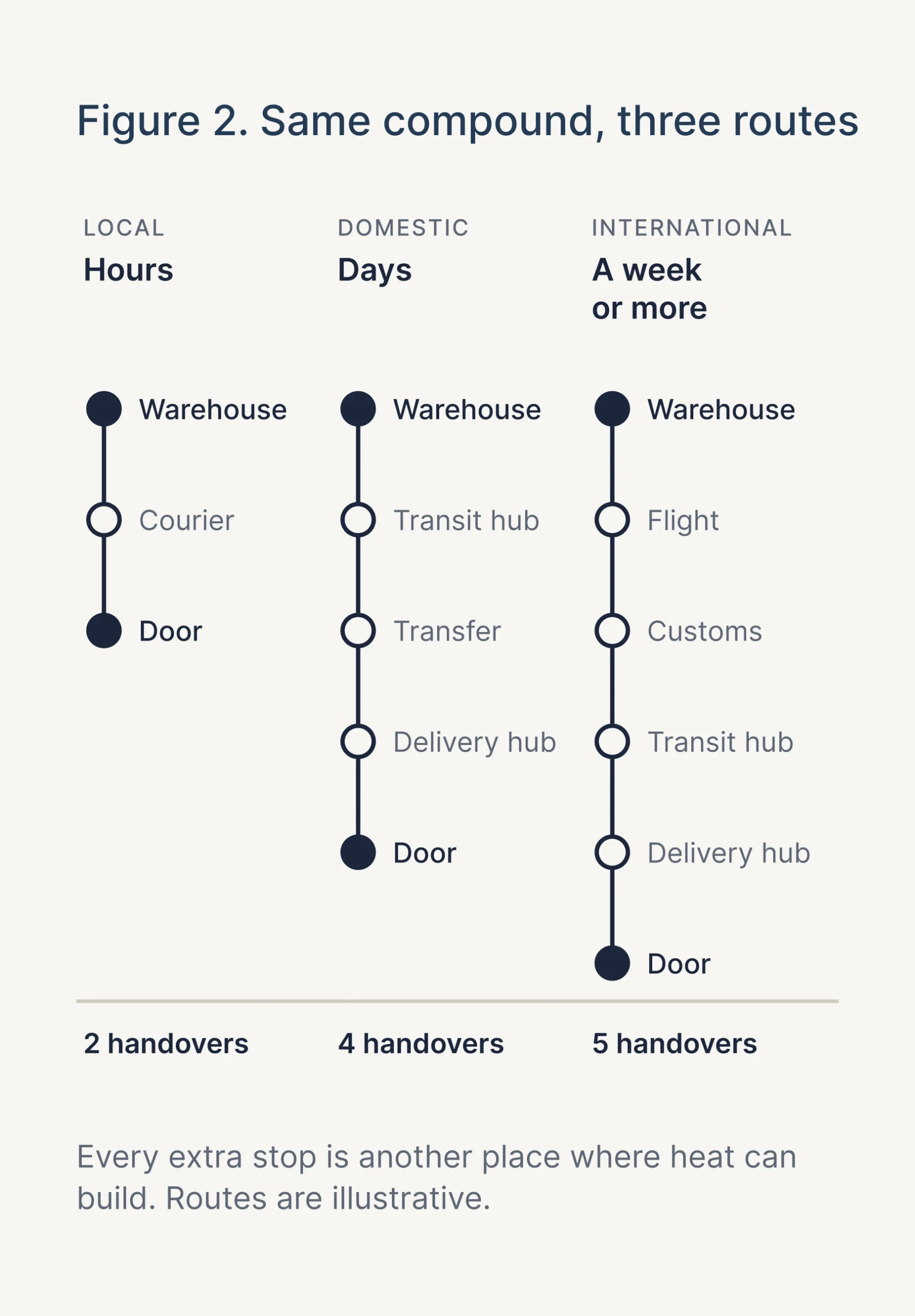
A longer route adds more than kilometers. It adds three things that each create a chance for heat:
- Days. Each extra day on the road is another afternoon in a van or a warehouse.
- Handovers. Each sorting hub means a loading dock, a wait and another vehicle.
- Borders. An international parcel goes through customs, where it can be held for checks. Storage areas there are not built around the needs of a peptide.
A parcel’s clock keeps running while it waits. Delays add exposure even when nothing is moving.
The question is not whether powder survives the trip. It is how much of its margin the trip uses.
4. The margin is shared
Transit is not the only claim on that margin. The same budget also covers time in storage before the order, and handling after it arrives.
A trip that uses half of it leaves half for everything else. A trip of a few hours leaves almost all of it.
This is why distance matters even when the vial looks perfect on arrival. Heat damage does not usually show. The powder can look the same and still have lost part of what the report measured.
5. What to ask about any route
Four questions cover most of it:
- Where does the order ship from? A city name, not just a country.
- How many days is it on the road? Ask for the usual range, not the best case.
- Does it cross a border? If yes, ask how customs delays are handled.
- What happens if it is delayed? A clear answer before ordering is worth more than an apology after.
How OPtide handles distance
- Two warehouses: stock is stored frozen in Bali and Jakarta.
- Closest first: each order ships from the nearer warehouse.
- Short trips: in the main cities, orders arrive by instant or next-day delivery.
- No borders: OPtide delivers within Indonesia only, so no order waits in customs.
A note on research use
OPtide compounds are supplied for laboratory research only. They are not for human consumption.
Shorter trips. More margin left.
Every order ships from the nearer of two warehouses, in Bali or Jakarta.