
In transit. Why lyophilized powder travels well.
and what the packaging is actually doing.
Topic tag: Handling & Storage
Read time: 3 min read
On This Page
Key takeaways
The packaging controls the two primary degradation mechanisms during shipping. Temperature is a secondary variable, not the primary concern.
Not all compounds hold equally under ambient conditions. Two groups apply across the OPtide range.
Lyophilized compounds are significantly more stable in transit than most people assume. The chemistry behind that stability is worth understanding.
Receipt is the first handling decision. It sets the baseline for everything that follows.
1. Why lyophilization changes the transit picture
Peptide degradation requires two things above all else: water and heat. Lyophilization, freeze-drying, removes water from the compound before it is sealed and shipped. What remains is a dry powder in a vacuum-sealed environment.
Without water, the two primary degradation pathways, hydrolysis and oxidation, have nothing to work with. This is why lyophilized compounds tolerate transit conditions that would compromise a reconstituted solution entirely. A package that spent an extra day in a warm distribution centre is not automatically a problem. The absence of moisture is doing the protective work, not the cold pack.
Lyophilization confers stability. It does not confer immunity. Prolonged exposure, broken seals, and accumulated handling stress all carry consequences. Understanding why the compound is stable makes it easier to recognise when that stability is genuinely at risk.
2. What the packaging controls
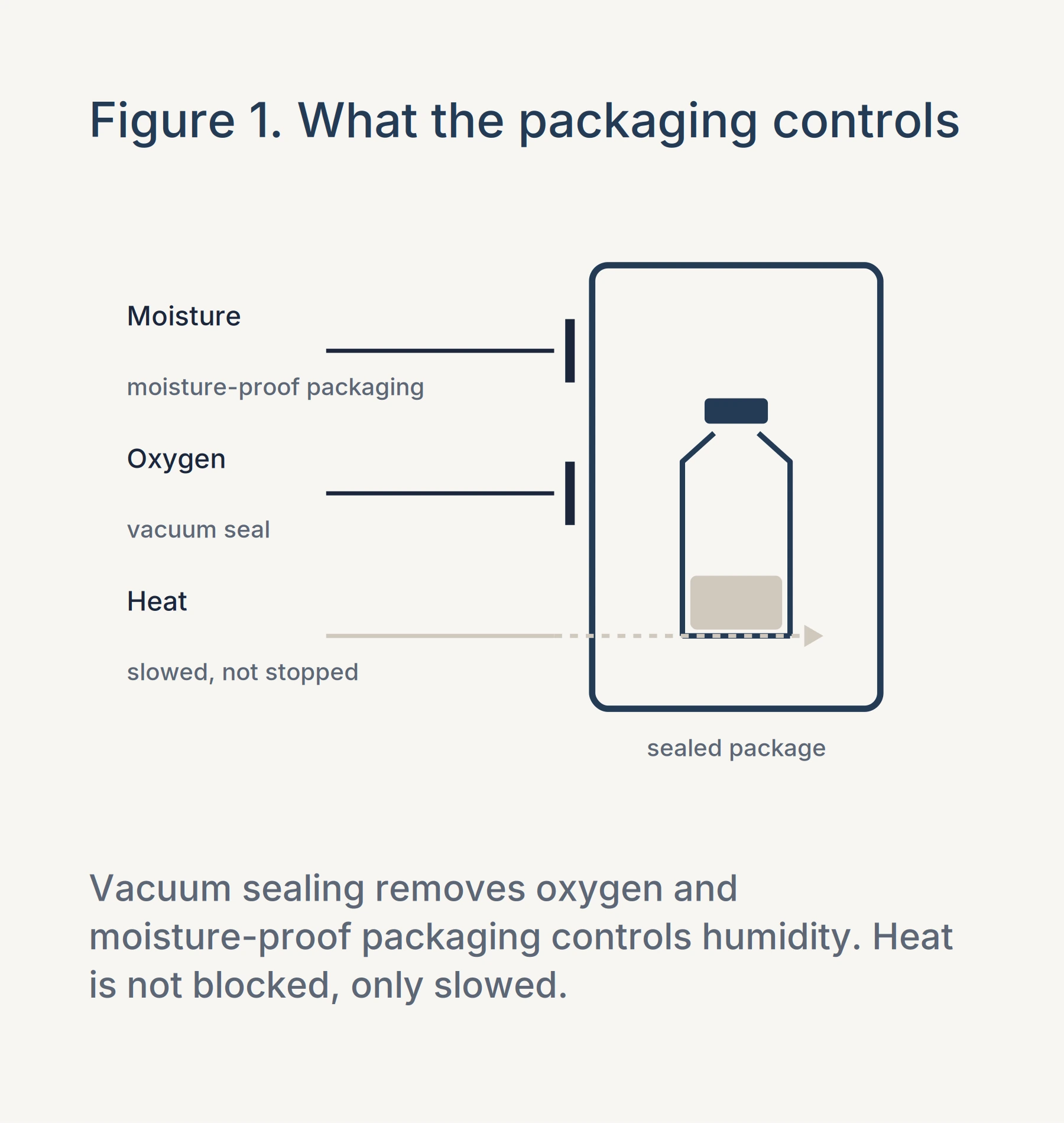
Two degradation mechanisms are controlled by the packaging itself. Vacuum sealing removes the oxygen that drives oxidation. Moisture-proof packaging controls the humidity that drives hydrolysis.
When both are controlled, temperature becomes a secondary variable. Still present, heat accelerates every degradation pathway, but operating at a fraction of its open-air rate. Compounds shipped in vacuum-sealed, moisture-proof packaging tolerate standard transit durations reliably.
That protection ends the moment the seal is broken. Once opened, both controls are gone. What follows is a different handling environment with different requirements.
3. Ambient windows by compound
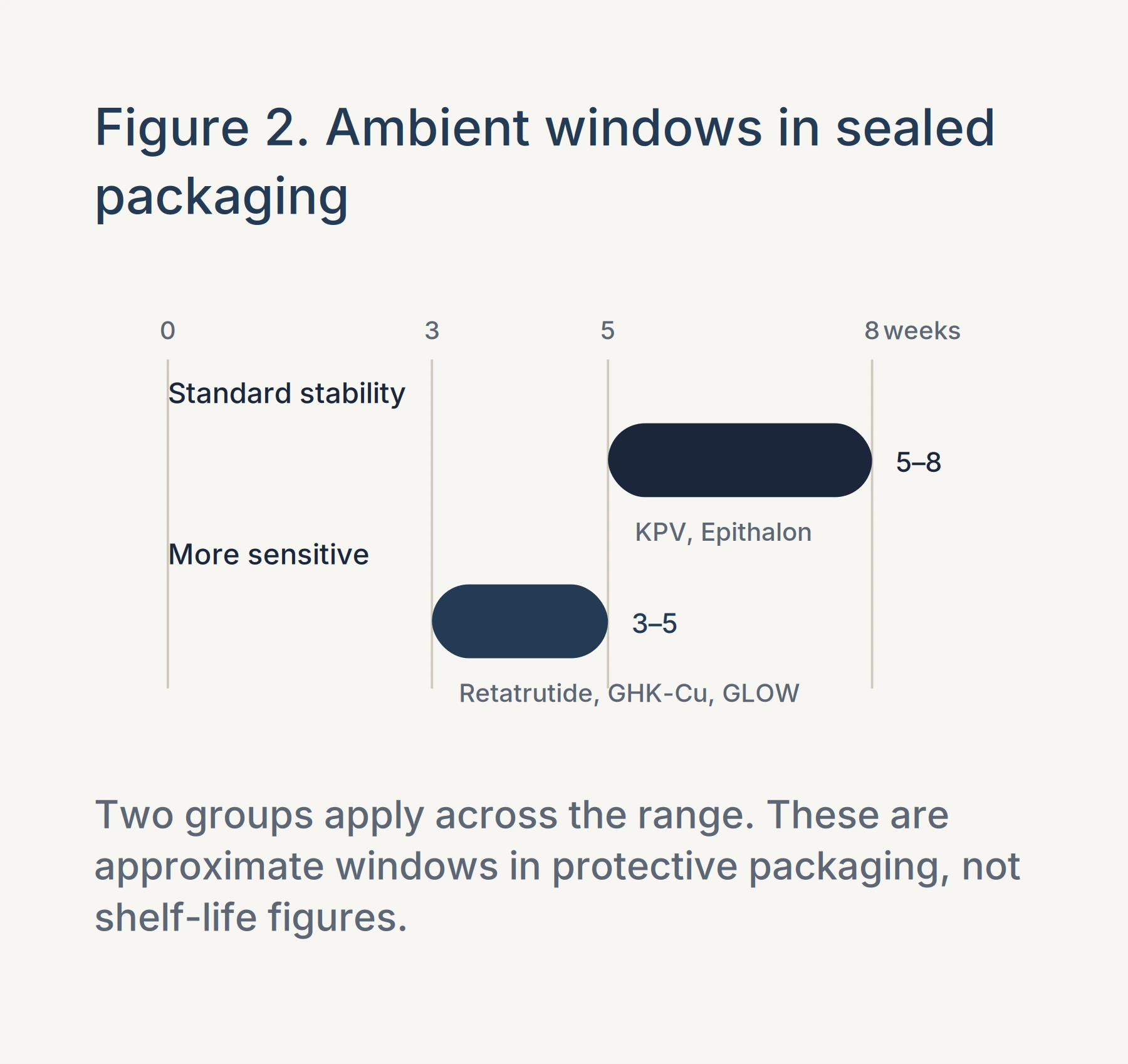
Not all compounds hold equally under ambient conditions. Two groups apply.
Standard stability, KPV, Epithalon
In vacuum-sealed, moisture-proof packaging, both compounds tolerate ambient conditions for approximately five to eight weeks. Neither contains oxidation-sensitive residues. KPV’s structural resistance comes from proline at position two. Epithalon’s primary vulnerability, hydrolysis at the Asp-Gly bond, is controlled by moisture-proof packaging.
More sensitive, Retatrutide, GHK-Cu, GLOW
The ambient window in protective packaging runs approximately three to five weeks for these compounds. Retatrutide’s longer sequence and deamidation risk require more careful handling. GHK-Cu’s sensitivity is copper-driven, photodegradation and redox instability are the primary concerns, both managed by sealed opaque packaging. GLOW’s ceiling is set by its GHK-Cu component and should be handled to the same standard.
The Certificate of Analysis documents the compound at the point of release. Handling after that point determines whether the data on it remains accurate.
4. On receipt
Refrigerate immediately at 2–8°C. This applies regardless of how the package arrived or how long it was in transit. Cold storage slows residual degradation from that point forward.
One practical note before opening: allow the sealed vial to reach room temperature first. Opening a cold vial in a warm environment causes moisture to condense on the cold surfaces, introducing uncontrolled water before reconstitution begins. Let the sealed vial equilibrate, then open.
What follows from that point, freeze-thaw management, reconstitution, and storage, is covered in the compound handling guide.
All compounds referenced are for research purposes only. Not for human consumption.
Stored frozen. Shipped close.
Stock waits in Bali and Jakarta, and each order ships from the nearer warehouse.