The COA. How to read it, line by line.
Topic tag: Testing & Verification
Read time: 5 min read
On This Page
Key takeaways
A COA describes one tested sample. It only counts if that sample matches the batch in hand.
Read it in order: who tested, what was tested, when, what was found, and how to check it.
Purity, identity and content answer different questions. A full COA reports all three.
The verification key matters most. A report that can be checked at the lab beats a polished PDF.
1. What a COA is
A certificate of analysis, or COA, is a lab’s report on one sample. It states what was tested, how it was tested, and what was found.
It is a record, not a promise. Its value depends on who made it and whether it can be checked.
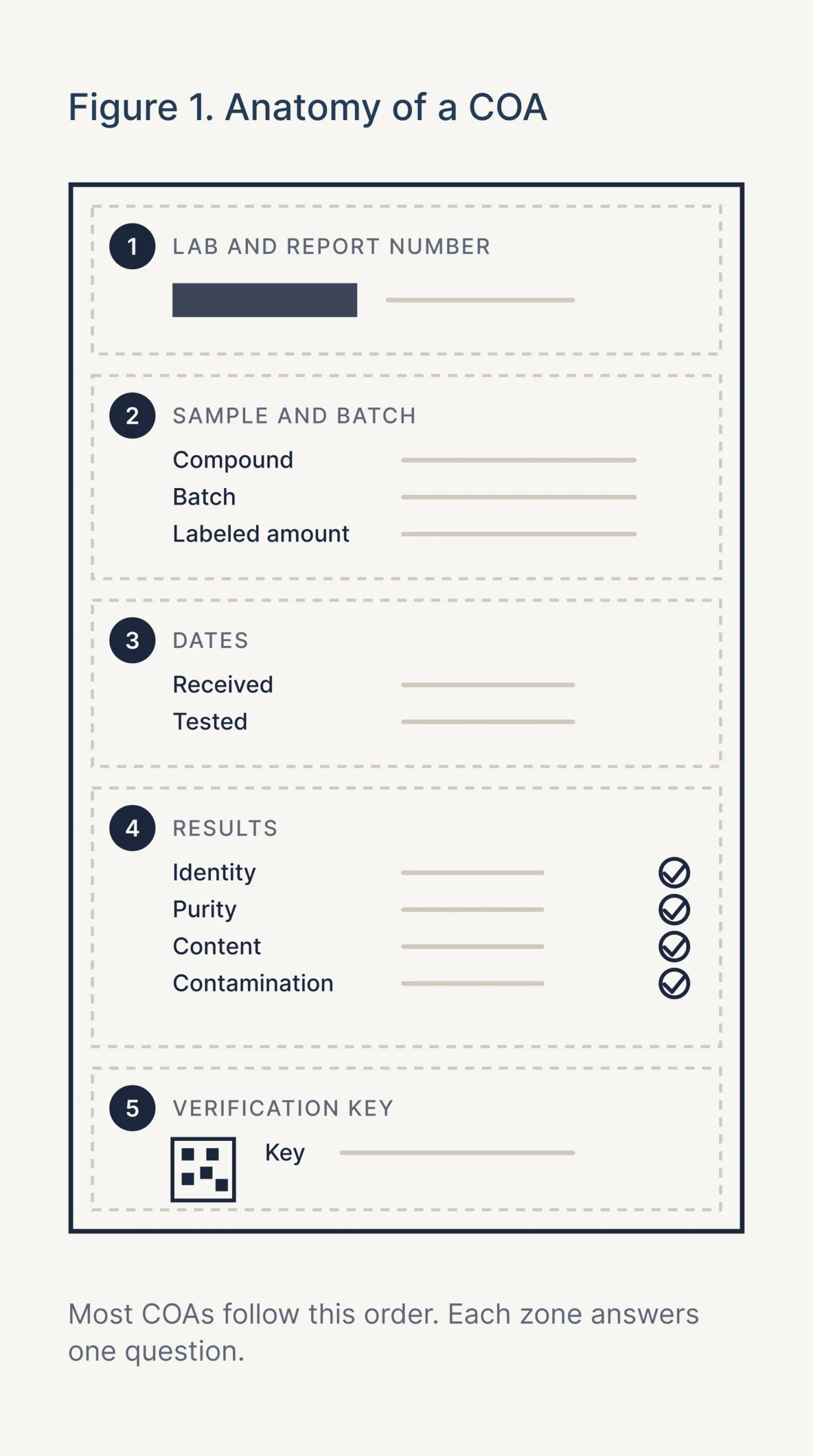
Most COAs follow the same order. Reading them in that order turns a dense page into five simple questions.
2. The header: lab and report number
The top of the report names the lab and gives the report a unique number. Many labs also print a verification key or a QR code.
Check two things here:
- The lab. Is it independent from the maker and the seller?
- The number. This is how the report is looked up later. A COA without one cannot be checked.
3. The sample: name, batch and amount
Next comes the sample itself:
- Compound name. The molecule the sample is claimed to be.
- Batch or lot number. The production run it came from. This has to match the vial or its tag.
- Labeled amount. For example, 10 mg. The results are judged against this.
Some reports also show who sent the sample to the lab.
4. The dates
A COA usually shows when the sample arrived, when it was tested, and when the report was issued.
The test date matters most. Shelf life is often counted from it, and it should fit the batch. A two-year-old report on a batch made last month does not add up.
5. Results: purity
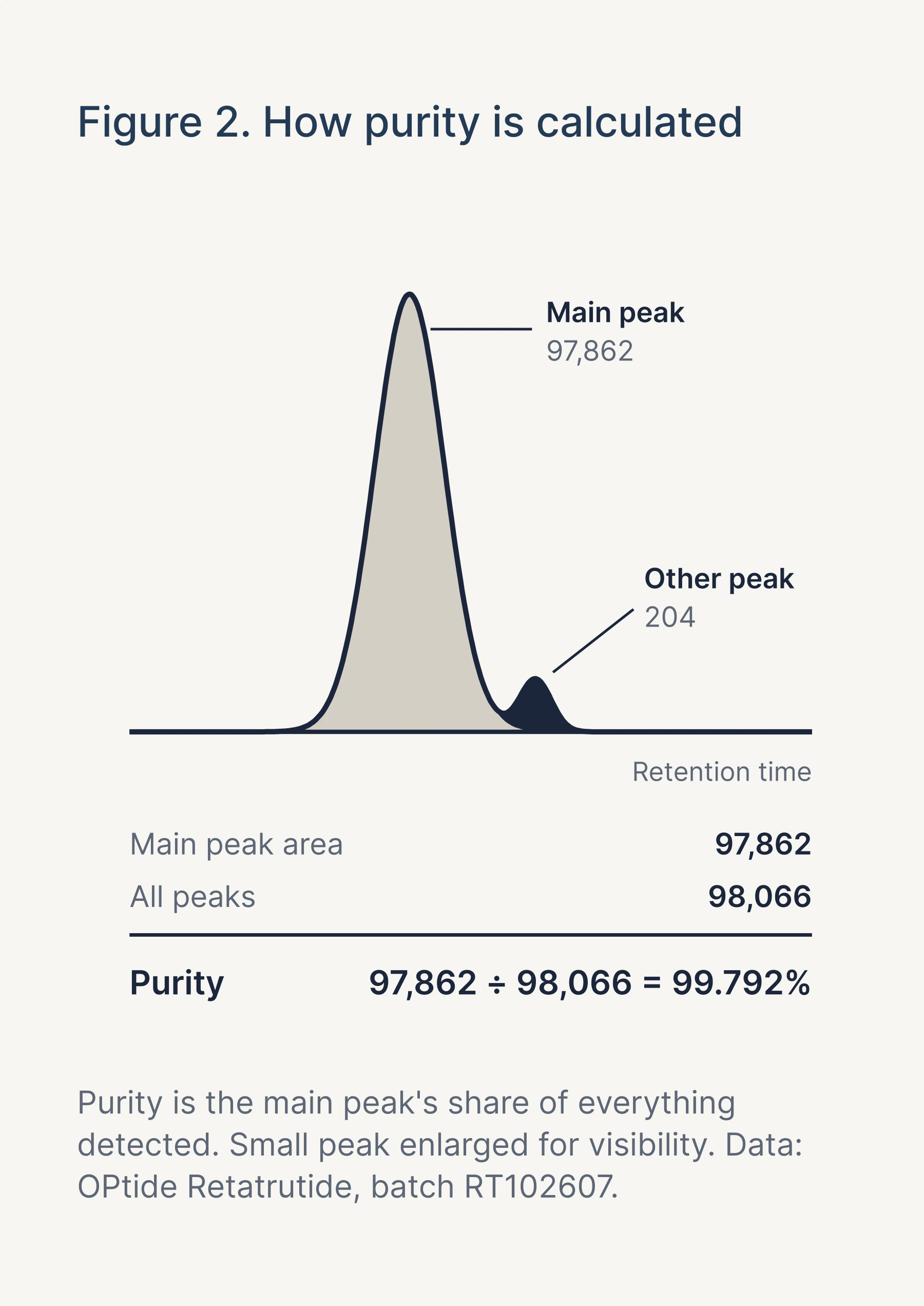
Purity is usually measured by HPLC, a method that separates a sample into its parts. Each part shows up as a peak on a chart.
The purity figure is the main peak’s share of everything detected. On a real OPtide Retatrutide report (batch RT102607), the main peak covers 97,862 area units out of 98,066 in total. That gives a purity of 99.792%.
Purity only counts what the detector can see. Water and salts do not show up as peaks, so purity alone does not say how much compound is in the vial.
Purity says how clean the compound is. Content says how much of it there is. A full COA needs both.
6. Results: identity and content
Identity confirms the molecule is what the label says. Mass spectrometry weighs the molecule and compares the measured mass with the expected one. A match confirms identity. A mismatch means a different molecule, whatever the purity.
Content is the amount actually in the vial, in milligrams. The same Retatrutide report measured 11.82 mg against a 10 mg label. A result slightly above the label is common, since many makers fill a little over. A result clearly below the label is worth asking about.
7. Results: contamination tests
A full report also checks for things that should not be there:
- Endotoxins. Fragments of bacterial outer membranes.
- Sterility. Any microbial growth.
- Heavy metals. Metals such as lead or mercury.
These are usually reported as pass or fail against a limit. Check that the limit is stated, not just the word “pass”.
8. The verification key
This is the step most people skip, and it matters most.
Enter the key on the lab’s own website. The details there should match the PDF exactly: compound, batch and results. If the lab’s record and the PDF disagree, trust the lab’s record.
What a COA cannot tell you
A COA describes the sample that reached the lab. On its own, it does not prove two things:
- That every vial in the batch is the same as the tested one.
- That the tested sample was chosen fairly.
Batch matching covers the first. How samples are chosen covers the second. Blind sample orders, explained in Before the first order, mean the maker cannot pick its best material for testing.
How OPtide COAs work
- Lab: every result comes from Janoshik Analytical, an independent third-party lab.
- Per batch: each batch has its own verification page, with links to Janoshik’s own records.
- As measured: results are shown exactly as reported, without rounding.
- Master lots: where a compound was filled from a larger master lot, some results come from that lot, and the report says so.
A note on research use
OPtide compounds are supplied for laboratory research only. They are not for human consumption.
Read a real one.
Every OPtide batch report is published, with links to the lab’s own records.