
Before the first order. What to ask a supplier.
Topic tag: Sourcing & Supply
Read time: 4 min read
On This Page
Key takeaways
A vial cannot show what is inside it. Only documents can, so ask for them before paying.
The lab should be independent, and its report should match the batch on the vial.
Purity is one result among several. Identity and content matter just as much.
Ask how problems are handled before there is a problem.
1. Why ask before ordering
Research peptides are freeze-dried into a thin white layer at the bottom of the vial. A correct vial and a wrong one look exactly the same.
The label states what the vial should hold. It cannot prove it.
That proof sits in the supplier’s documents. Asking for them costs nothing, and a good supplier answers quickly. The six questions below cover what matters most.
2. Who tested it?
Start with the lab. An independent lab is separate from both the maker and the seller, so it has no stake in the result.
Ask for the lab’s name. Then check two things:
- The lab exists and runs this kind of analysis.
- The report can be checked on the lab’s own website. Many labs print a verification key or link on each report for exactly this reason.
A report that only exists as a PDF from the seller asks for trust. A report that can be opened at the source does not.
3. Is the report for this batch?
A batch, also called a lot, is one production run. Two batches of the same compound can test differently.
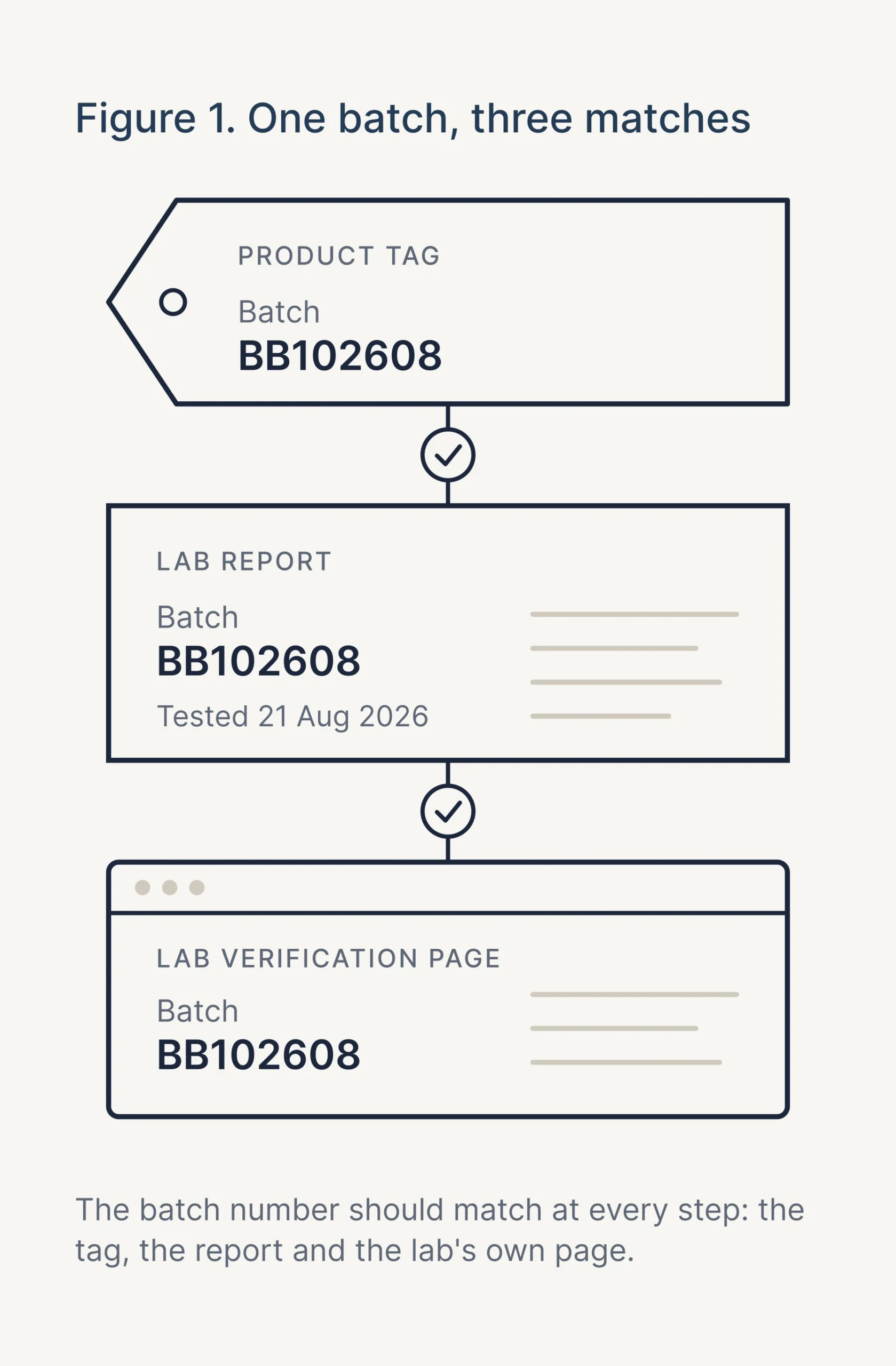
So the report has to belong to the batch that arrives. Check that:
- The batch number on the report matches the number on the vial or its tag.
- The test date fits that batch.
A report with no batch number, or one reused across many batches, describes some other vial. The batch also sets the shelf life, which is usually counted from the batch test date.
4. What was tested?
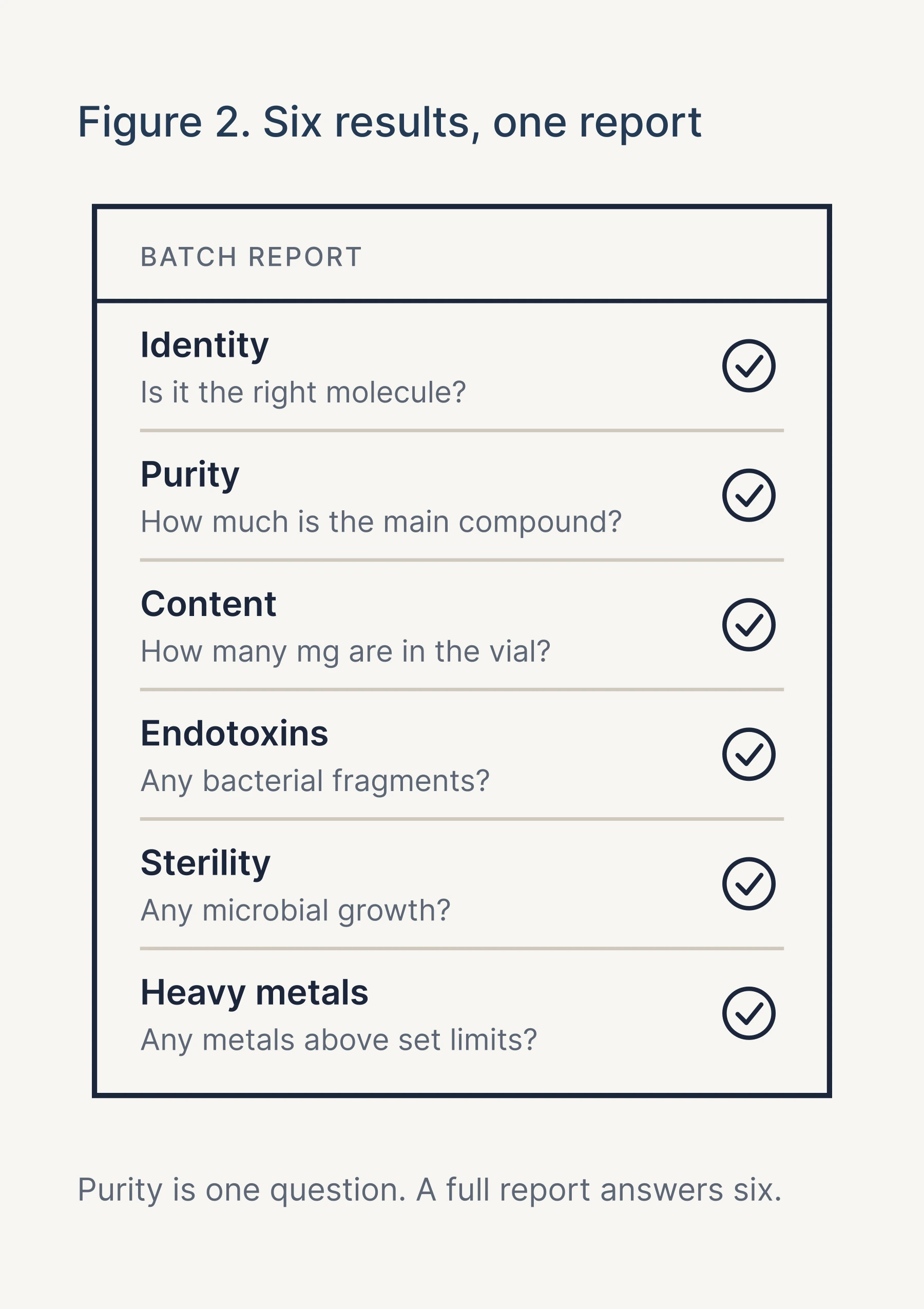
Purity is the number most often quoted. It is not the whole picture. A full report answers several separate questions:
- Identity. Is this the molecule named on the label? Mass spectrometry, a method that weighs molecules, confirms it.
- Purity. What share of the material is the main compound? This is usually measured by HPLC, a method that separates a sample into its parts.
- Content. How many milligrams are actually in the vial, compared with the amount on the label?
- Endotoxins. Are there fragments of bacterial outer membranes? Even small amounts can disturb cell-based experiments.
- Sterility. Is there any microbial growth?
- Heavy metals. Are metals such as lead or mercury present above set limits?
A vial can be very pure and still hold the wrong molecule, or less than the label says. Identity and content close those gaps.
Names can hide this too. TB-500 is used for two different molecules: a short fragment of seven amino acids, and the full 43-amino-acid thymosin beta-4. Only the identity result shows which one a batch contains.
A label is a claim. A batch report is evidence, but only when it belongs to the batch in hand.
5. How was the maker approved?
Good results at the end start with good choices at the beginning. Ask how the supplier chose its manufacturer.
One strong answer is blind sample orders. The buyer orders samples without saying who they are, then sends them for testing. The manufacturer cannot hand-pick its best material, because it does not know the order is a test.
6. Where is the stock, and how far does it travel?
Ask where stock is held and where the order ships from. Then ask how long the parcel will be on the road.
Freeze-dried powder handles short periods at room temperature well. A long route, a customs hold or a hot sorting hub uses up part of that margin. A closer warehouse means fewer days in transit and fewer handovers.
7. What happens if something goes wrong?
Ask this before paying, not after. A clear supplier states:
- How long there is to report a problem.
- What evidence is needed, such as photos or an unboxing video.
- Who to contact, and how quickly they reply.
Written terms protect both sides. Vague promises protect no one.
How OPtide answers these
- Lab: Janoshik Analytical, an independent third-party lab. Each result links to Janoshik’s own verification page.
- Batch: each batch has its own verification page, with the reports for that batch.
- Tests: identity, purity, content, endotoxins, sterility and heavy metals. Where a compound was filled from a larger master lot, some results come from that master lot, and the report says so.
- Approval: blind sample orders before any supplier is approved.
- Stock: held in Bali and Jakarta. Each order ships from the closer warehouse.
- Problems: report within 24 hours of receipt, by email or WhatsApp, with an unboxing video.
A note on research use
OPtide compounds are supplied for laboratory research only. They are not for human consumption.
The reports come first. The order comes second.
Every OPtide batch is tested by Janoshik, and the results are published before purchase.