
GHK-Cu. A tripeptide that carries copper.
Topic tag: Compound Profiles
Read time: 6 min read
On This Page
Key takeaways
The copper ion is not incidental. It is functionally central to how the compound works.
The research spans wound healing, collagen synthesis, and gene expression modulation, across a broader range of biological systems than most compounds its size.
GHK-Cu is not synthetic in origin. It occurs naturally in human plasma, and the story of how it was discovered is what set fifty years of research in motion.
One of the more visually distinctive compounds in the range. The blue-purple colour is the copper. It should be there.
1. The discovery
In 1973, a biochemist named Loren Pickart was studying what caused liver cells from older donors to behave differently from those of younger donors. When plasma from young donors was added to older liver cells, something in the plasma caused those cells to start behaving more like younger ones. Pickart isolated the active component. It was a small tripeptide, Glycine-Histidine-Lysine, that occurred naturally in human blood.
That peptide was GHK. The copper-bound form, GHK-Cu, followed. The research has not stopped since.
What made the discovery significant was not just the finding itself. It was the implication: that a naturally occurring compound, present in the body, appeared to influence how cells function, and that its concentration in plasma declines with age. That observation opened a research direction that is still active fifty years later.
2. What GHK-Cu is
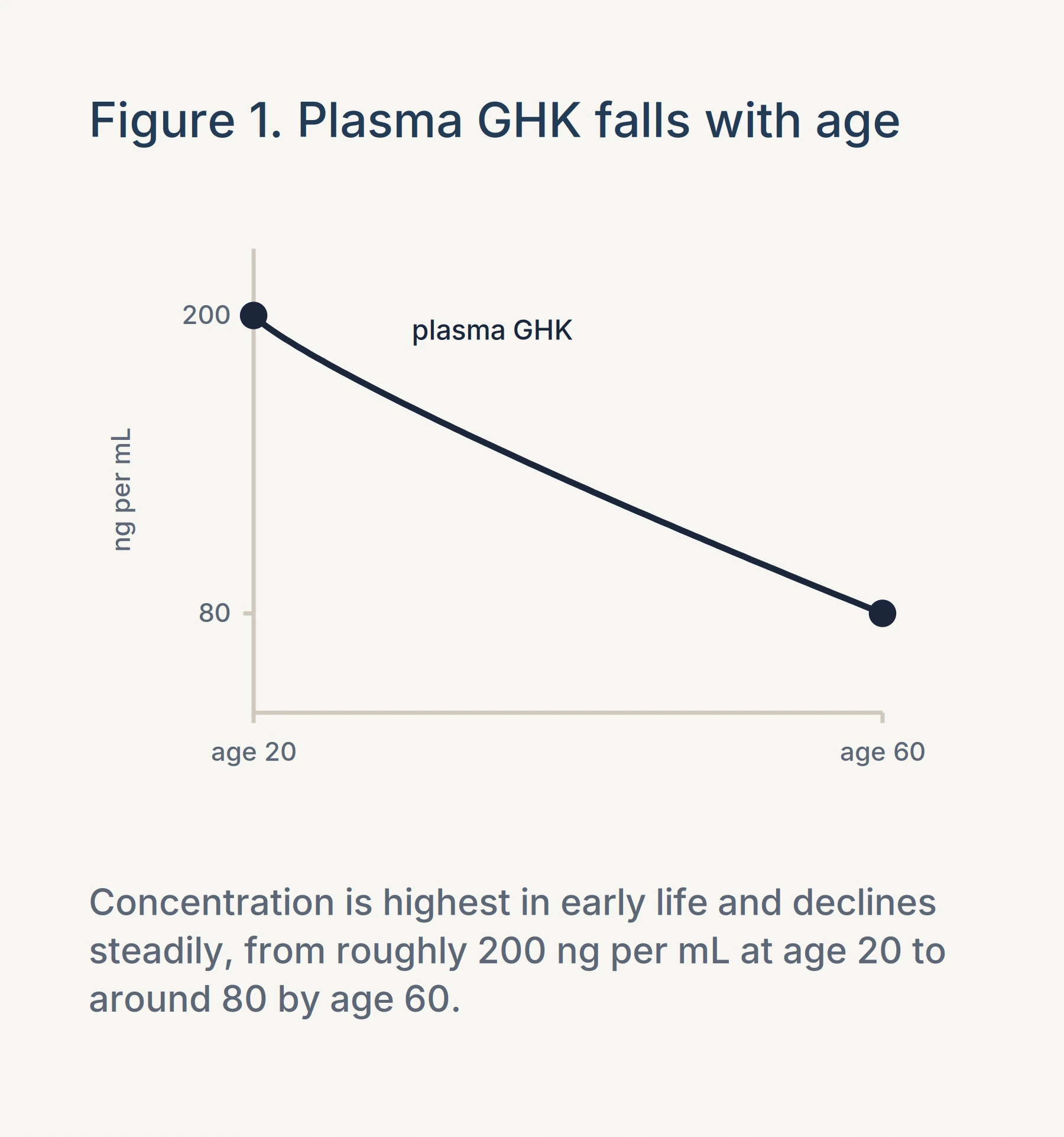
GHK-Cu is a tripeptide, Glycine, Histidine, Lysine, complexed with a copper ion. It is naturally present in human plasma, saliva, and urine. Concentration in plasma is highest in early life and decreases significantly with age, from approximately 200 nanograms per millilitre at age 20 to around 80 nanograms per millilitre by age 60.
It presents as a blue to blue-purple powder in lyophilized form. The colour comes from the copper ion. It is a reliable visual indicator of compound integrity, a white or off-white appearance in a GHK-Cu sample would raise questions about the copper complex.
3. The role of copper
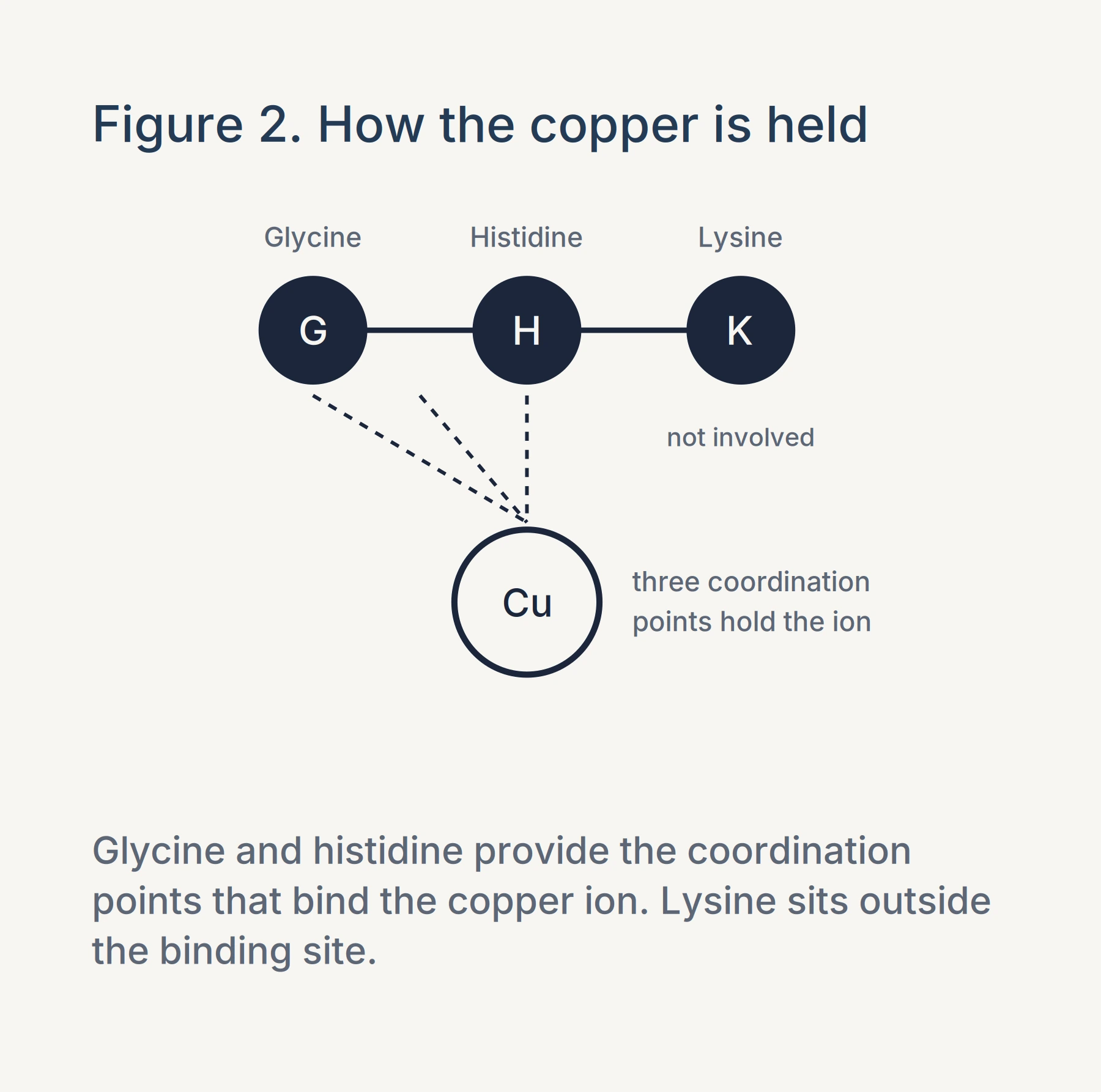
Copper is not a passenger in this compound. It is central to how GHK-Cu functions. The copper ion stabilises the peptide’s structure and is directly involved in the biological activity the research has examined, collagen synthesis, enzyme activity, antioxidant response. GHK alone has activity. GHK-Cu consistently demonstrates greater activity across the same research parameters.
This also explains the compound’s sensitivity to certain handling conditions. Copper is reactive. Photodegradation and redox instability are the primary concerns, both driven by the metal ion at the centre of the complex. Light protection and sealed storage are not precautions. They are requirements.
4. What the research explores
The research profile of GHK-Cu is broader than most compounds of comparable size. Several distinct areas have accumulated meaningful preclinical evidence.
Collagen synthesis and tissue remodelling The most established body of research. GHK-Cu has been studied extensively for its role in stimulating collagen, elastin, and glycosaminoglycan production in fibroblast models and animal studies. It influences not only synthesis but also the enzymes responsible for breaking down and remodelling the extracellular matrix, the structural scaffold that gives tissue its integrity. The research focus is on the balance between production and remodelling, not simply on collagen output alone.
Wound healing Preclinical wound healing models, including ischemic skin flap studies, diabetic wound models, and full-thickness wound studies across multiple species, have produced consistent results. GHK-Cu has been studied for its influence on wound closure rates, blood vessel formation, and the reduction of inflammatory markers in healing tissue.
Gene expression modulation The most expansive area of GHK-Cu research, and the one that has attracted the most attention in recent years. Published studies have investigated the compound’s influence on gene expression across a significant number of biological pathways, with findings suggesting effects on inflammation, DNA repair, and cellular metabolism. The scope of that influence is what continues to drive research interest beyond the wound healing and skin regeneration contexts where GHK-Cu first established its research profile.
Skin regeneration A subset of the wound healing and collagen research, but extensive enough to be its own category. GHK-Cu has been studied in topical models for its influence on skin tissue remodelling, fibroblast activity, and markers associated with skin ageing at the cellular level.
The colour is the compound. Blue to blue-purple means the copper complex is intact. Treat the handling accordingly.
5. A note on research context
GHK-Cu has one of the longer research histories in this compound range, over fifty years of preclinical and some clinical investigation. The evidence base for wound healing and skin regeneration applications is among the most established in peptide science. Gene expression research is more recent and ongoing.
All compounds supplied through OPtide are for preclinical and in vitro research purposes only. Not for human consumption.
For compound specifications, batch documentation, and storage guidance, see the GHK-Cu product page.
Copper bound. Purity measured.
Every GHK-Cu batch is tested by Janoshik, and the results are published before purchase.