
KLOW. GLOW, plus the inflammation question.
Topic tag: Compound Profiles
Read time: 4 min read
On This Page
Key takeaways
KLOW holds four peptides: GHK-Cu, BPC-157, TB-500 and KPV, 80 mg in total.
The first three are GLOW. KPV is what makes KLOW a different research tool.
GLOW is built around repair. KPV adds a second question: what the inflammation around repair is doing.
Each part has its own preclinical record. Research on all four together is limited.
1. What is in the vial
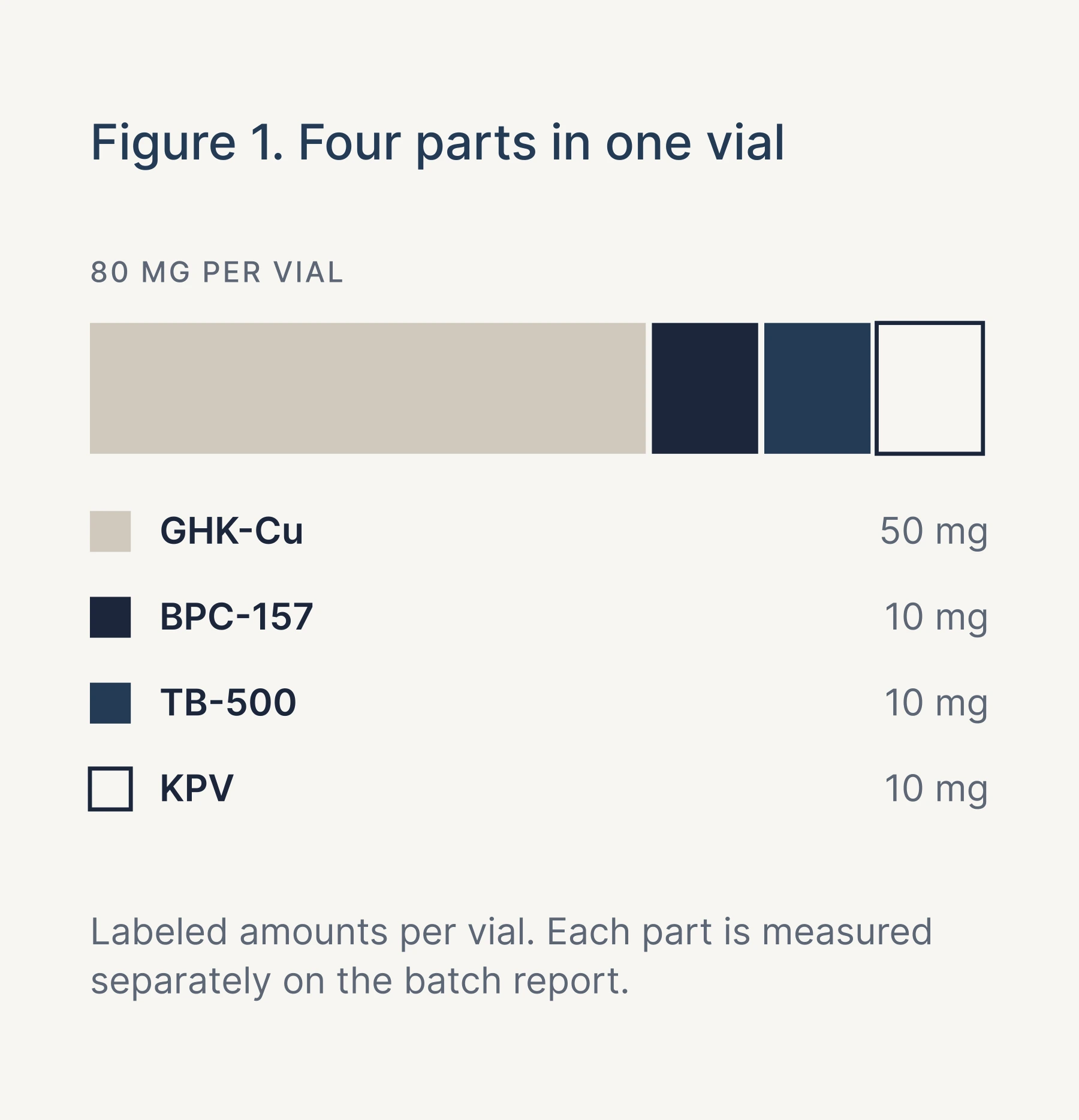
KLOW is a blend of four peptides, freeze-dried together: 50 mg of GHK-Cu and 10 mg each of BPC-157, TB-500 and KPV.
Because it is a blend, the parts are measured separately. On batch KL802607, Janoshik measured 88.35 mg in total, with 11.75 mg of KPV, 11.77 mg of BPC-157 and 11.21 mg of TB-500. As in all OPtide batches, the TB-500 is full-length thymosin beta-4.
2. The GLOW part
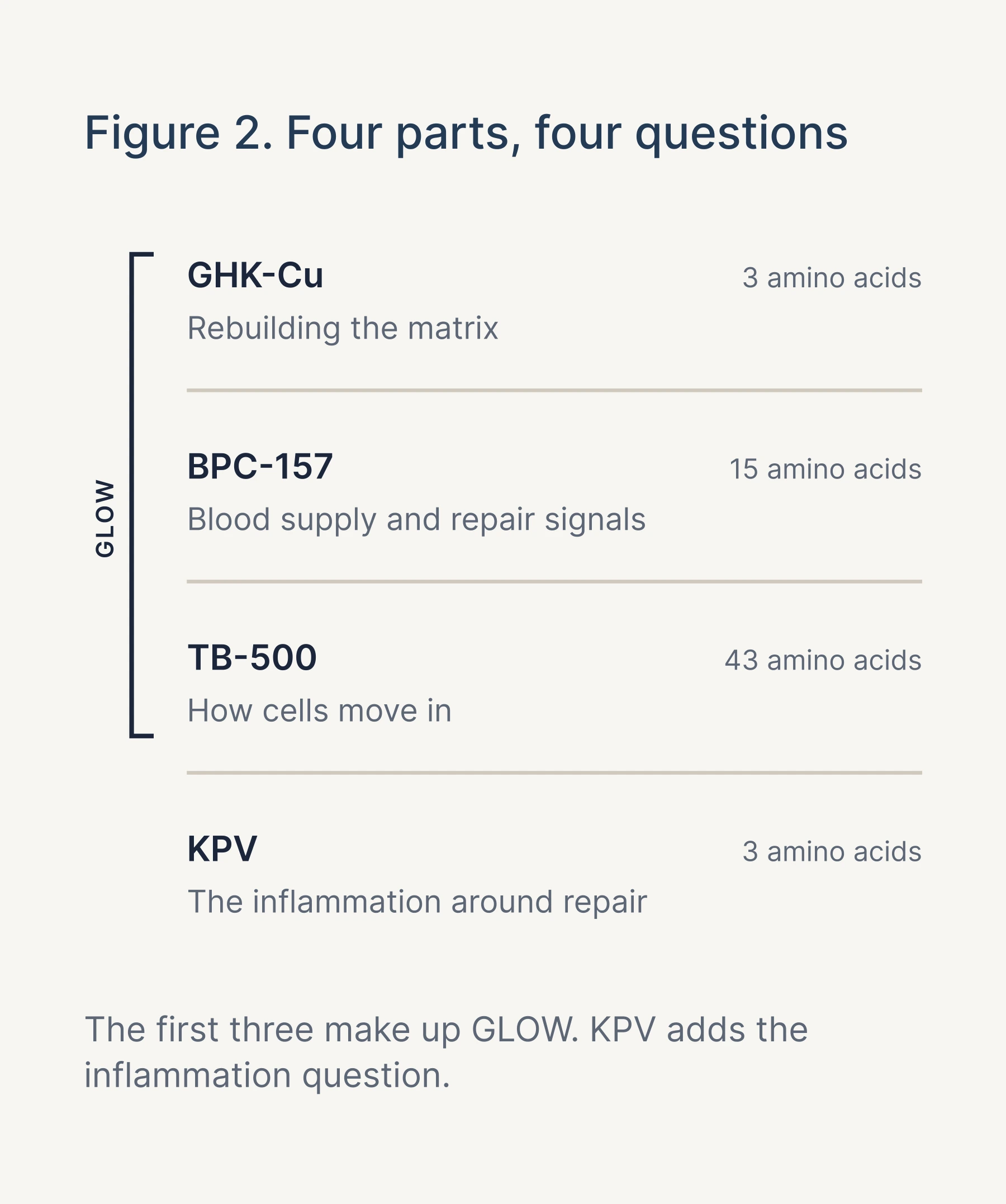
Three of the four peptides make up GLOW. Each is studied for a different step of tissue repair:
- BPC-157: blood supply and repair signals.
- TB-500 (thymosin beta-4): how cells move into the damaged area.
- GHK-Cu: rebuilding the matrix, the scaffold of collagen and other proteins that holds tissue together.
Our GLOW article covers these three in more depth.
3. What KPV adds
KPV is a chain of just three amino acids: lysine, proline and valine. It is the tail end of a natural hormone called alpha-MSH.
It enters cells through a transporter called PepT1, found on gut and immune cells. Inside, it dampens NF-kB, a switch that turns on inflammatory signals. Our KPV article covers it in full.
Inflammation is a normal part of repair. When it runs too long or too strongly, preclinical work shows it can get in the way of the same steps GLOW is built around.
GLOW asks how repair works. KLOW also asks what the inflammation around it is doing.
4. Four parts, four questions
Each part of KLOW points at a different research question. That is the point of the blend: one vial that covers the repair steps and the inflammation around them.
5. KLOW or GLOW
The choice depends on the question, not on which is bigger.
- GLOW fits research on the repair steps themselves.
- KLOW fits research on whether managing inflammation changes those steps.
Using KLOW where GLOW would do adds a variable without adding an answer.
6. A note on the evidence
Each of the four peptides has its own body of preclinical research. Studies of all four together are scarce.
For two of them, BPC-157 and TB-500, a 2026 rat study tested the pair directly and found no added benefit over either alone in early tendon repair. Our Wolverine article covers that study. The case for combining them rests on mechanisms, and the direct evidence is still early.
How OPtide tests KLOW
- Full panel: KLOW is a master lot, tested for identity, content per component, endotoxins, sterility and heavy metals.
- Published: results are shown per batch, with links to Janoshik’s own records.
A note on research use
OPtide compounds are supplied for laboratory research only. They are not for human consumption.
Four peptides. One batch record.
Every KLOW batch is tested by Janoshik, with each part measured and published.