
Wolverine. Two peptides, two separate jobs.
Topic tag: Compound Profiles
Read time: 4 min read
On This Page
Key takeaways
Wolverine is two peptides in one vial: 5 mg of BPC-157 and 5 mg of TB-500.
BPC-157 is studied mainly for blood supply and repair signals. TB-500 is studied for how cells move.
The TB-500 in OPtide batches is full-length thymosin beta-4, 43 amino acids long, confirmed by the lab.
Each peptide has a large preclinical record. Research on the pair is new, and so far it is mixed.
1. What is in the vial
Wolverine is a blend of two peptides, freeze-dried together in one vial: 5 mg of BPC-157 and 5 mg of TB-500.
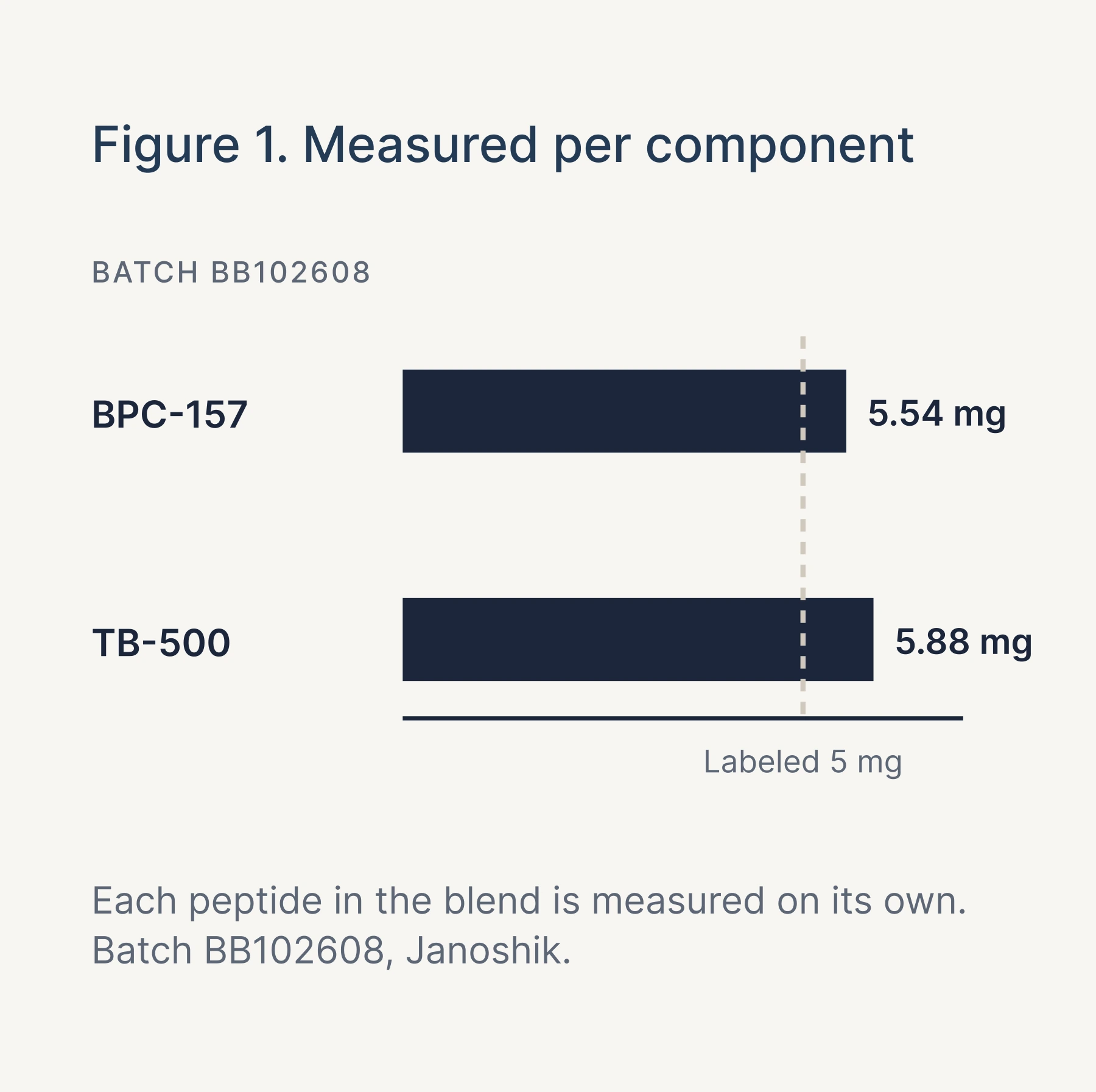
Because it is a blend, each peptide is measured on its own. On batch BB102608, Janoshik measured 5.54 mg of BPC-157 and 5.88 mg of TB-500.
2. BPC-157
BPC-157 is a synthetic chain of 15 amino acids. Its sequence comes from a protein found in human gastric juice, and it was first described in 1992.
Most of the research is preclinical, in cells and animals. It has focused on a few mechanisms:
- Blood vessel growth. Higher levels of VEGF, a key growth signal for new vessels.
- Nitric oxide. Effects on the pathway that controls blood flow.
- Tendon cells. In cultured tendon cells, more growth hormone receptors and activity in a pathway that helps cells attach and spread.
A 2025 systematic review found 36 studies on BPC-157 in muscle and tendon research. Only one of them was clinical. The authors called the evidence promising but limited.
3. TB-500: what is actually in the vial
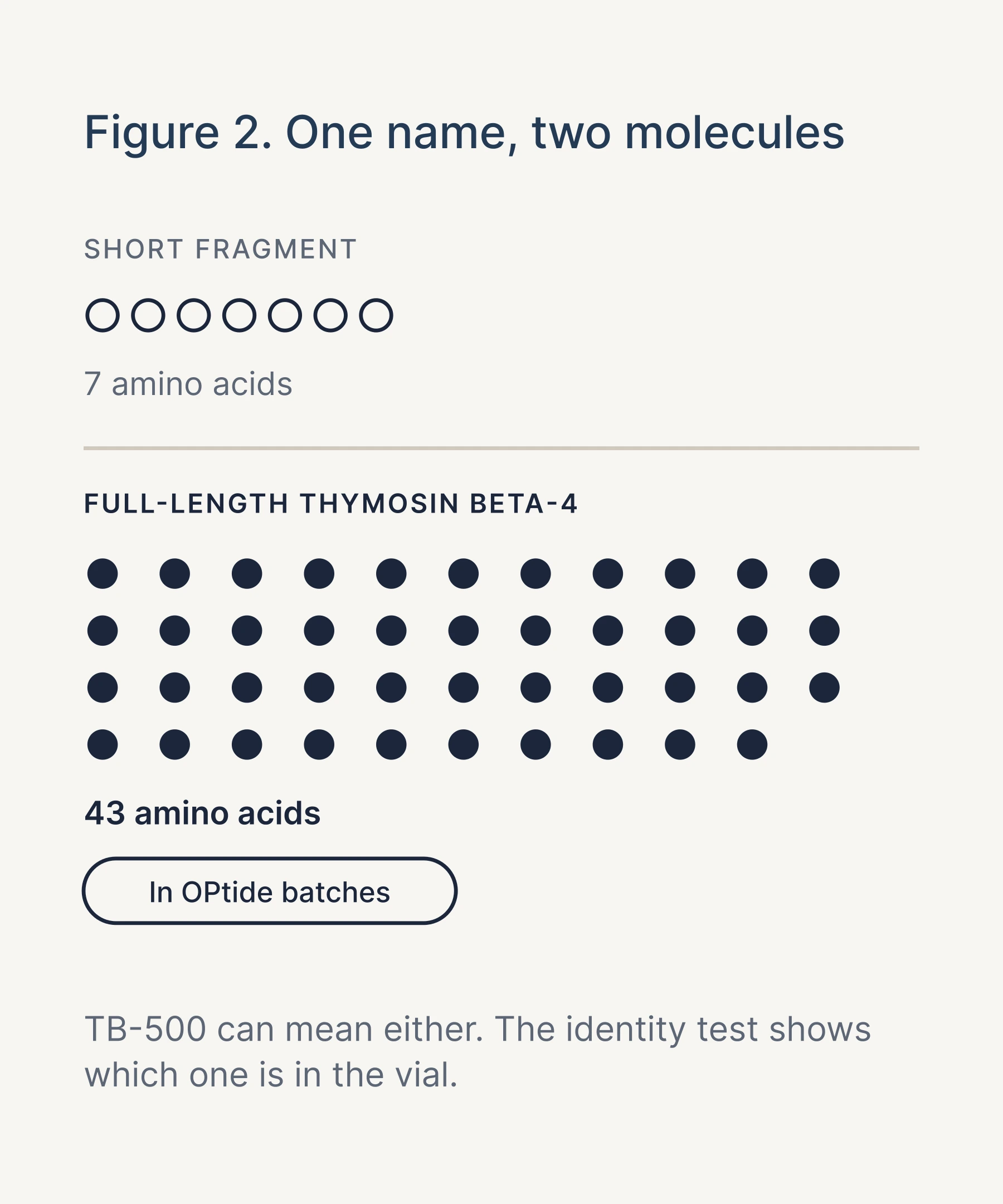
The name TB-500 causes confusion. It was first used for a short synthetic fragment of thymosin beta-4. Today it is used for both that fragment and the full-length molecule.
In OPtide batches, TB-500 is full-length thymosin beta-4: 43 amino acids. The lab’s identity test confirms which molecule is present.
Thymosin beta-4 is found in almost every cell. Its main job is to hold single actin units, the building blocks cells use to build the filaments they move with. By controlling that supply, it influences how cells migrate, which is why it is studied in repair models.
4. Why the two are studied together
The two peptides are studied for different steps of the same process. BPC-157 research centers on blood supply and repair signals. Thymosin beta-4 research centers on cells moving into the damaged area.
That difference is the reason for combining them. The question is whether two separate mechanisms add up to more than either alone.
Two mechanisms make a reason to study a pair. They do not prove the pair works better.
5. What the combined research shows
Direct research on the pair is very recent. In 2026, a rat study of Achilles tendon repair, published in Joint Diseases and Related Surgery, compared four groups: no treatment, BPC-157, TB-500, and both together.
After four weeks, both peptides were linked to better tissue structure, and TB-500 also to a stronger tendon. The combination did not do better than either peptide alone. The authors called the study exploratory and asked for longer, larger studies.
So the case for the pair is mechanistic, and the direct evidence is early. That is an open research question, which is what research material is for.
How OPtide tests Wolverine
- Per component: each peptide is measured separately, with its own result.
- Identity: testing confirms the TB-500 is full-length thymosin beta-4.
- Published: results are shown per batch, with links to Janoshik’s own records.
A note on research use
OPtide compounds are supplied for laboratory research only. They are not for human consumption.
Two peptides. Two results.
Every Wolverine batch reports BPC-157 and TB-500 separately, linked to the lab’s own records.