
Endotoxins. Why the limit is not one fixed number.
Topic tag: Testing & Verification
Read time: 4 min read
On This Page
Key takeaways
Endotoxins are fragments of bacteria. They survive heat, so a sterile sample can still contain them.
Even small amounts can change how cells behave, which makes them a real source of noise in research.
An official limit is worked out from how a finished medicine is used. Research material has no such use, so there is no single number.
The measured value says more than the word "pass". To compare vials of different sizes, divide by the milligrams in each.
1. What endotoxins are
Endotoxins come from the outer wall of a common group of bacteria, called gram-negative bacteria. Chemically, they are lipopolysaccharides: a fat-like anchor joined to a chain of sugars.
Bacteria release them as they grow, and in larger amounts when they die.
Two things make them hard to deal with. They are very heat-stable, so normal sterilization does not destroy them. And they stick readily to plastic and glass.
Sterile is not the same as endotoxin-free. Endotoxins can outlast the bacteria that made them.
2. Why they matter in research
Immune cells are built to detect endotoxins, and they react to very small amounts. In cell-based experiments, that reaction can switch on signals the researcher never meant to trigger.
The result is noise. An effect that looks like it came from the compound may have come from contamination instead. This is why endotoxin testing matters even for material that never leaves the lab.
3. How they are measured
The standard method is the LAL test. It uses an extract from horseshoe crab blood that clots when it meets endotoxin. The strength of that reaction shows how much is present.
Results are given in endotoxin units, or EU. One EU equals roughly 0.1 to 0.2 nanograms of endotoxin. A nanogram is a billionth of a gram, which shows how sensitive the test is.
4. Why there is no single limit
For a finished medicine, the limit is not picked from a table. It is worked out.
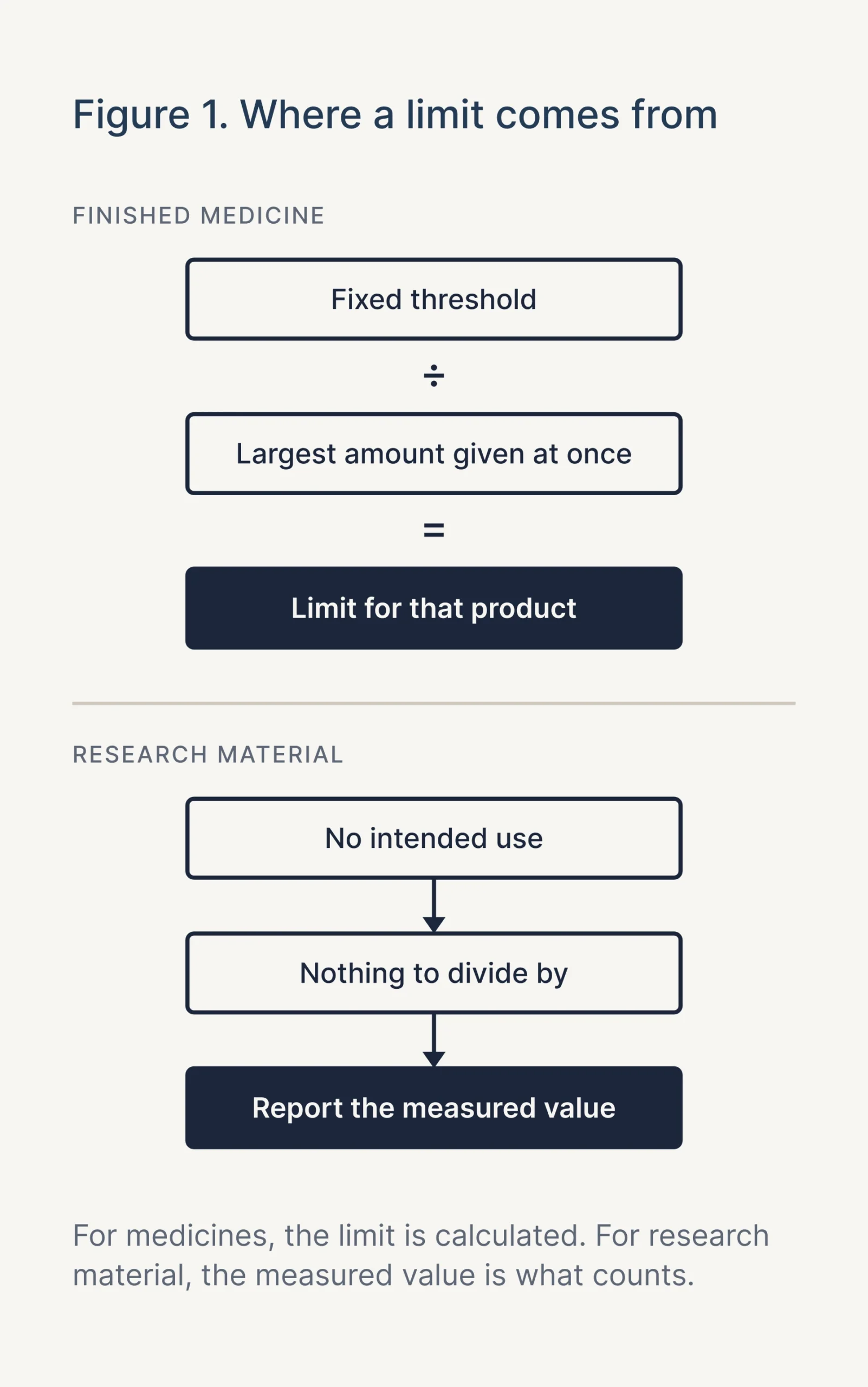
The pharmacopoeias, the official reference books for medicines, start from a fixed threshold. They divide it by the largest amount of the medicine given at one time. The answer is that medicine’s limit.
Because the second number changes from product to product, so does the limit. Two medicines can have very different limits, and both can be correct.
5. What that means for research material
Research material has no intended use of that kind, so the formula has nothing to divide by. There is no single official endotoxin limit for it.
What remains is the measured value. A lab may also report a pass against a threshold it applies, but the number says more than the word. Lower is better, and a result well below the threshold leaves more room.
6. Per vial or per mg
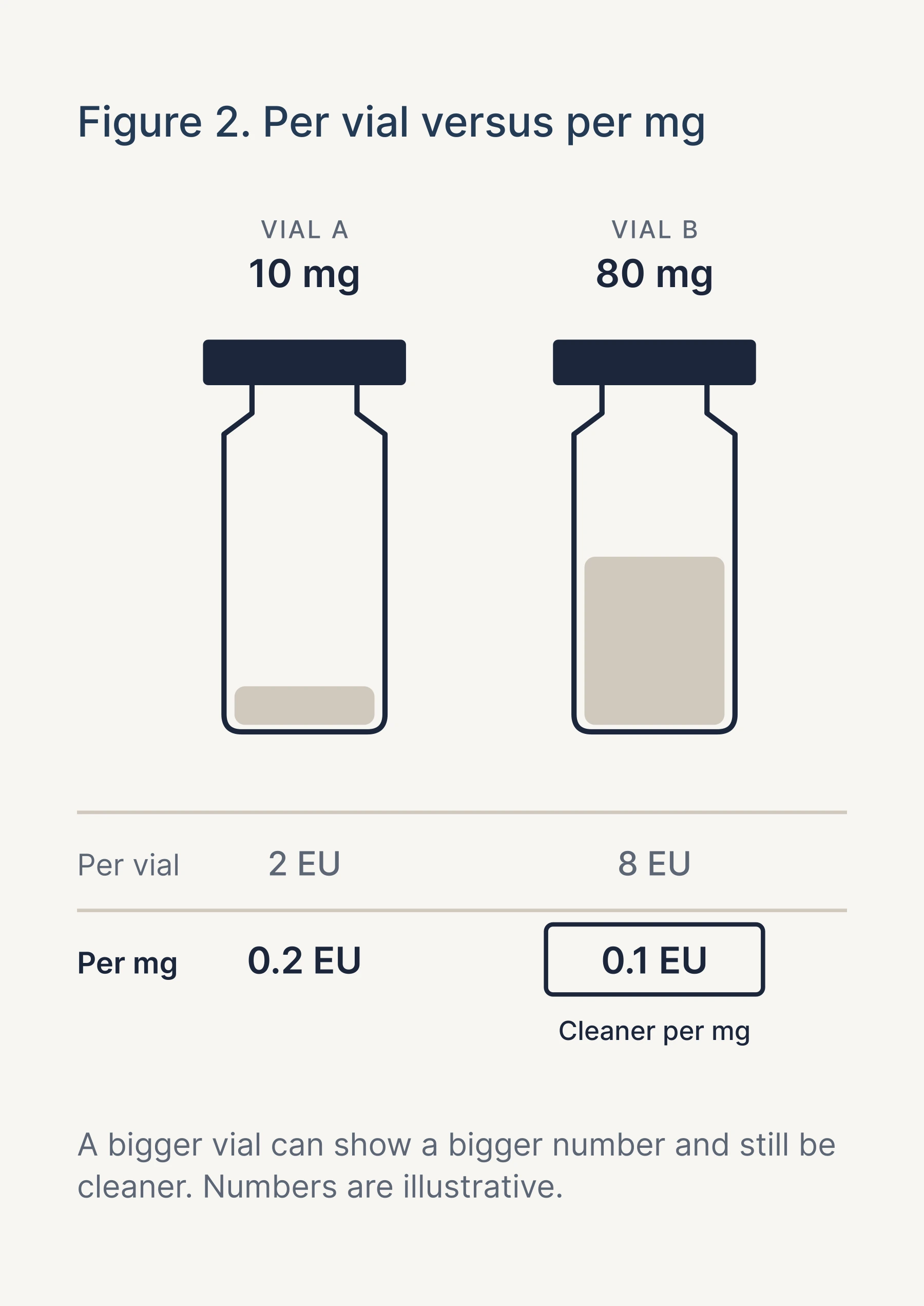
Results are often given per vial. That number depends on how much material the vial holds.
A large vial can show a higher figure per vial and still be cleaner per milligram. To compare two vials of different sizes, divide each result by the milligrams in the vial.
How OPtide reports endotoxins
- Every batch: each batch is tested for endotoxins by Janoshik Analytical.
- The number, not only the word: each batch page shows the measured value in EU per vial, next to the lab’s result.
- At the source: every result links to Janoshik’s own record of the test.
A note on research use
OPtide compounds are supplied for laboratory research only. They are not for human consumption.
Numbers, not just a pass.
Every OPtide batch page shows the measured endotoxin value, linked to the lab’s own record.