
GLOW. Three peptides, one question.
Topic tag: Compound Profiles
Read time: 4 min read
On This Page
Key takeaways
GLOW combines three compounds that each address a different phase of that sequence. The research interest is in how they interact, not just what each does alone.
BPC-157 and TB-500 are among the most studied repair peptides in preclinical science. GHK-Cu has its own post, the depth of that research profile is worth reading separately.
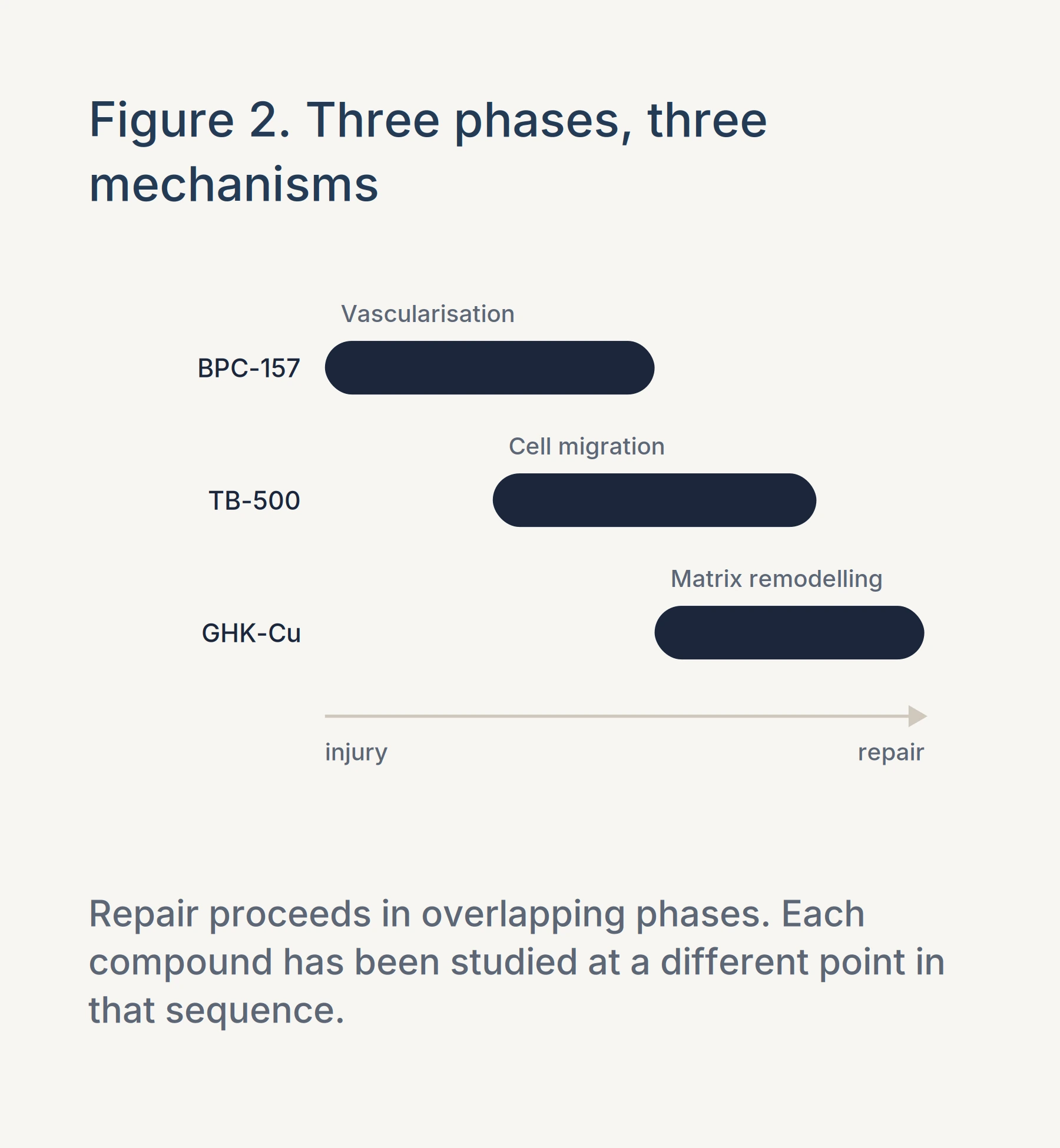
Tissue repair is not a single event. It is a sequence of biological processes, vascularization, cell migration, matrix remodeling, each with its own mechanism and timeline.
As with all compounds in this range, supplied for preclinical research purposes only.
1. What GLOW is
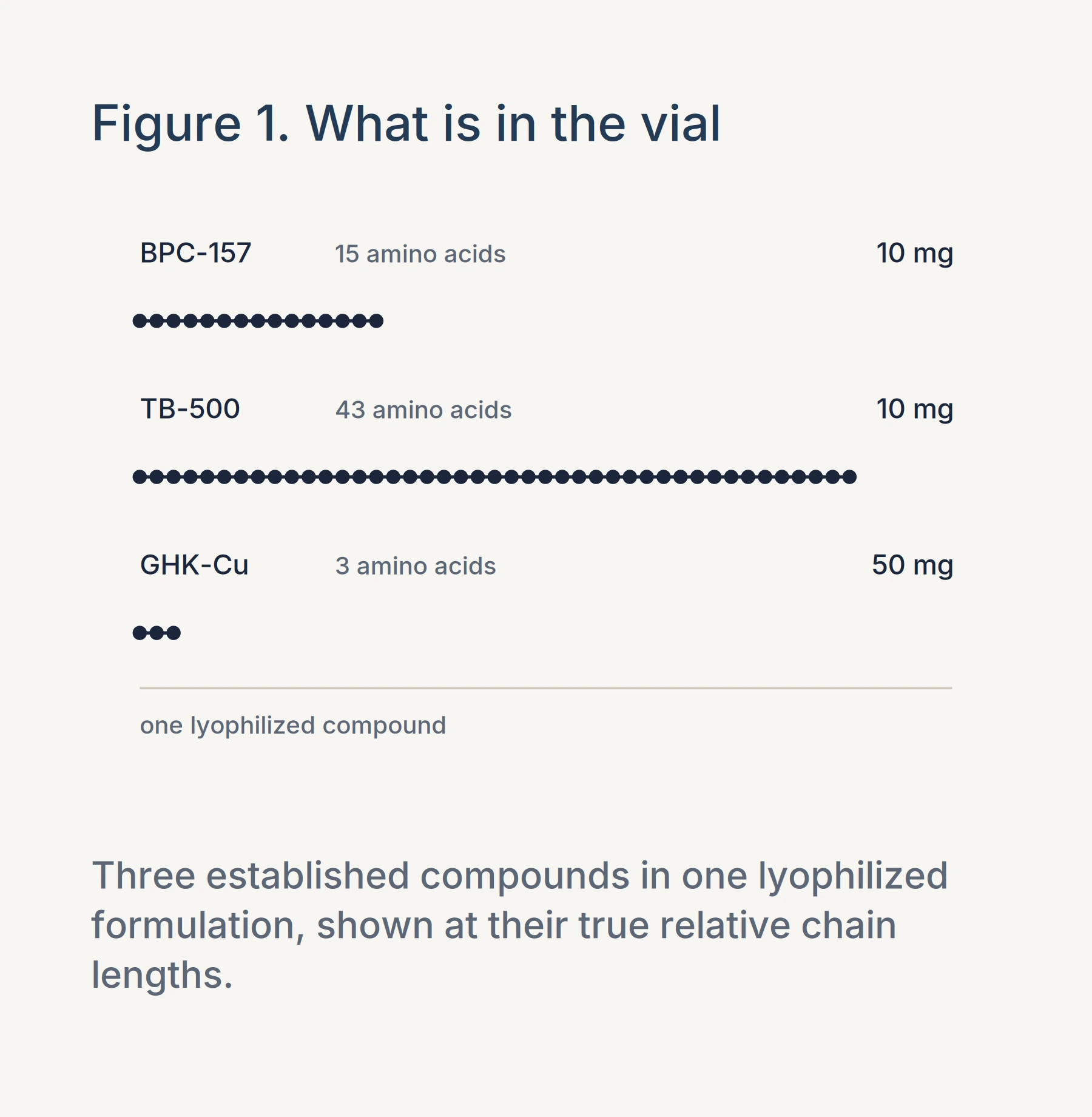
GLOW is a triple-peptide blend containing BPC-157, TB-500, and GHK-Cu. It is formulated as a single lyophilized compound, 10mg BPC-157, 10mg TB-500, and 50mg GHK-Cu, supplied for use in preclinical tissue repair research.
Each component is an established research compound in its own right. The reason they are studied together is not simply that all three relate to repair. It is that each operates through a distinct mechanism, at a different point in the repair process. Studying them in combination allows researchers to investigate how those mechanisms interact, something that studying each compound alone does not make possible.
2. BPC-157, the vascularization mechanism
BPC-157 is a synthetic 15-amino acid peptide derived from a protective protein sequence found in gastric tissue. It has one of the most extensive preclinical research profiles of any peptide currently studied, hundreds of published studies across multiple animal models and tissue types.
The central mechanism the research has focused on is angiogenesis, the formation of new blood vessels. Tissue that lacks adequate blood supply heals poorly. Tendons, ligaments, and connective tissue are particularly vulnerable because they are naturally low in vascularity. BPC-157 has been studied for its ability to stimulate the growth of new blood vessels into damaged tissue, improving oxygen and nutrient delivery to the repair site.
Beyond angiogenesis, research has examined BPC-157’s influence on nitric oxide pathways, growth factor signalling, and the protection of tissue under conditions of cellular stress. The gastrointestinal research context, from which the compound was originally derived, remains an active area alongside the musculoskeletal repair literature.
3. TB-500, the cell migration mechanism
TB-500 is the name used for synthetic thymosin beta-4, a naturally occurring 43-amino acid protein involved in the organization of the cellular skeleton. In OPtide batches it is the full-length molecule, confirmed by the lab’s identity test. Its research profile is distinct from BPC-157’s in a specific and meaningful way.
Where BPC-157 research focuses on vascular supply, getting blood to the repair site, TB-500 research focuses on what happens at the cellular level once the repair process begins. Thymosin beta-4 plays a key role in actin dynamics, the regulation of actin, a protein that controls cell shape, movement, and division. TB-500’s influence on actin polymerization is the mechanism through which it has been studied for cell migration and tissue remodeling.
In practical research terms: BPC-157 helps establish the conditions for repair. TB-500 helps organize the cells doing the repairing. Direct research on the two together is still early. A 2026 rat study of tendon repair found no added benefit from the pair over either peptide alone, so the case for combining them rests on their different mechanisms. Our Wolverine article covers that study.
Three mechanisms. Three phases. Vascularization, cell migration, matrix remodeling. The blend is designed around the sequence, not just the destination.
4. GHK-Cu, the matrix mechanism
GHK-Cu is covered in depth in its own compound post, the research history alone spans five decades and merits the space. In the context of GLOW, its role is specific.
Once vascularization is established and cells have migrated to the repair site, the extracellular matrix, the structural scaffold of the tissue, needs to be rebuilt. That is where GHK-Cu’s research profile is most relevant. Collagen synthesis, elastin production, glycosaminoglycan regulation, and the enzymes that govern matrix remodeling are all areas where GHK-Cu has accumulated preclinical evidence.
The 50mg weighting in GLOW’s formulation reflects GHK-Cu’s role as the matrix-phase component, the part of the repair sequence that determines the structural quality of what is rebuilt.
5. Why the combination is studied
The mechanistic rationale for combining these three compounds is straightforward: tissue repair is not a single event. It proceeds in phases, each dependent on the previous one, each requiring different biological inputs.
Studying a single repair compound tells researchers what that mechanism contributes. Studying compounds in combination tells researchers how mechanisms interact, whether they potentiate each other, whether timing matters, whether the presence of one changes the behavior of another. Those are different questions, and they require a different research tool.
GLOW is formulated to enable that combination research. The three compounds cover distinct but overlapping phases of the repair process. The research interest is in the intersection.
6. A note on research context
All three components of GLOW have established preclinical research profiles. The evidence base for individual compounds is well-documented. Research into combination protocols is an active and developing area, the mechanistic rationale is sound, and the preclinical direction is consistent, but the combination literature is less extensive than the individual compound literature.
All compounds supplied through OPtide are for preclinical and in vitro research purposes only. Not for human consumption.
For compound specifications, batch documentation, and storage guidance, see the GLOW product page.
Three peptides. Each one measured.
Every GLOW batch reports each peptide separately, linked to the lab’s own records.