
Epithalon. Four amino acids and the telomere question.
Topic tag: Compound Profiles
Read time: 6 min read
On This Page
Key takeaways
Telomeres are not complicated. They are protective structures at the end of chromosomes that shorten as cells age. That shortening is one of the most studied mechanisms in cellular biology.
Epithalon is studied for its ability to activate telomerase, the enzyme responsible for maintaining telomere length.
Epithalon was developed from pineal gland research in the Soviet Union in the 1980s. The science behind it has been active ever since, with a Nobel Prize awarded along the way for the broader biology it works within.
The research base is real and substantial. It also comes predominantly from one research group, and independent replication remains limited. Both facts matter.
1. The origin
In the 1970s and 80s, a Soviet biogerontologist named Vladimir Khavinson was studying the relationship between the pineal gland (a small structure in the brain responsible for regulating circadian rhythms and melatonin production) and the ageing process. His research identified that extracts from pineal tissue appeared to influence cellular ageing markers in laboratory models. From those extracts, Khavinson and his team synthesised Epithalon, a four-amino-acid peptide designed to replicate the activity of a naturally occurring pineal compound called epithalamin.
The research that followed spans more than four decades. It sits within a broader field of telomere biology that, in 2009, was recognised with the Nobel Prize in Physiology or Medicine, awarded for the discovery of how chromosomes are protected by telomeres and the enzyme telomerase.
2. What telomeres are and why they matter
Every time a cell divides, it copies its DNA. That copying process is not perfect at the ends of chromosomes. A small section is lost with each division. Telomeres are the protective structures at the end of chromosomes that absorb that loss. Think of them as the plastic tips at the end of a shoelace: they protect the functional part of the chromosome from fraying.
Over time, as cells divide repeatedly across a lifetime, telomeres shorten. When they become critically short, the cell can no longer divide safely. It enters a state called senescence (a kind of biological retirement), or it undergoes programmed cell death. The cumulative effect of that process across billions of cells is one of the defining features of cellular ageing.
Telomere length is not the only mechanism of ageing. But it is one of the most studied, most measurable, and most directly connected to how cells behave over time. That is what makes it a significant research area, and what placed Epithalon at the centre of it.
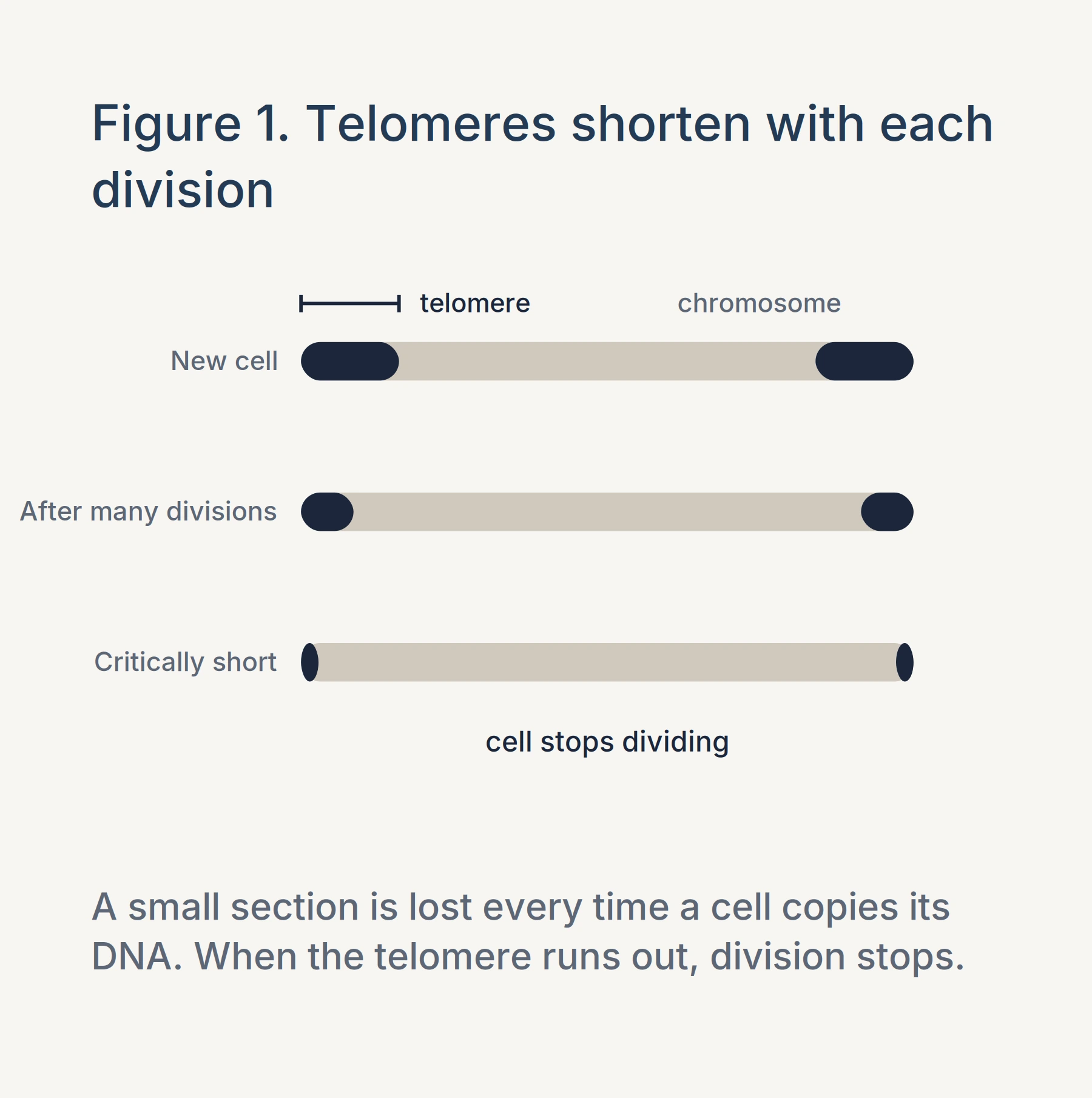
Telomeres shorten as cells divide. When they run out, cells stop working properly. The question Epithalon research asks is whether that process can be influenced.
3. What Epithalon is
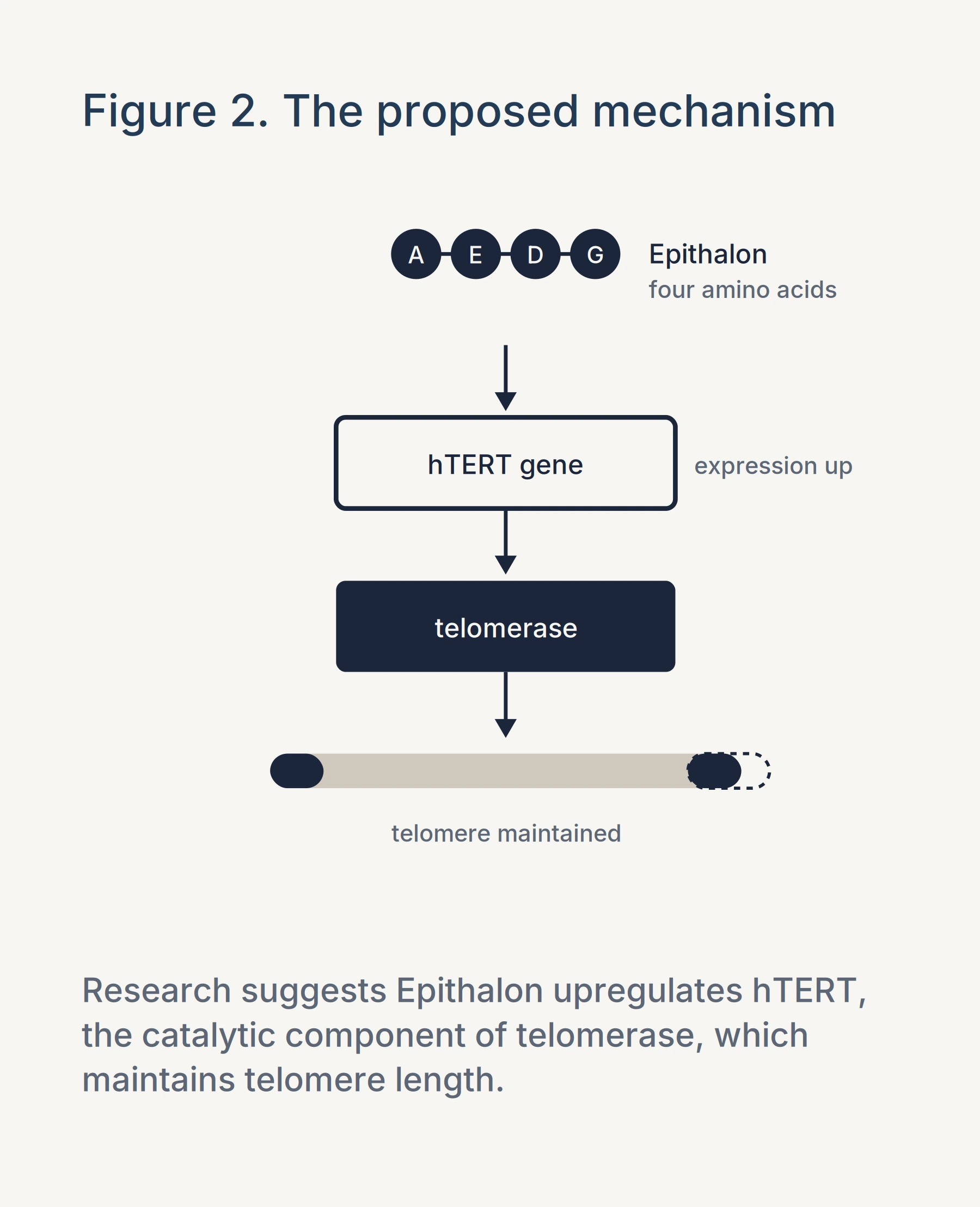
Epithalon is a synthetic tetrapeptide, four amino acids in sequence: Alanine, Glutamic acid, Aspartic acid, Glycine (AEDG). It is small even by peptide standards. Its compact structure has made it relatively straightforward to study in cell culture systems, which is one reason the preclinical research base is as extensive as it is.
4. The mechanism, telomerase activation
Telomerase is an enzyme with a specific function: it rebuilds telomeres. Most adult cells express very little telomerase, which is why telomeres shorten over time rather than being continuously maintained. Cancer cells are a notable exception; they express telomerase in abundance, which is part of what makes them capable of dividing indefinitely. The relationship between telomerase, telomere length, and cellular behaviour is one of the most active areas in molecular biology.
Epithalon has been studied for its ability to activate telomerase in human somatic cells, the ordinary dividing cells of the body, as distinct from reproductive cells. Published research, including a 2003 study in the Bulletin of Experimental Biology and Medicine, demonstrated that Epithalon induces telomerase activity and telomere elongation in human somatic cells. That finding established the mechanistic foundation for the research that followed.
The proposed mechanism involves Epithalon’s interaction with the hTERT gene, the catalytic component of the telomerase enzyme, upregulating its expression in dividing cells. In plain terms: the research suggests Epithalon may prompt cells to produce more of the enzyme responsible for maintaining the structures that protect chromosomes from age-related shortening.
5. What the research explores
The primary and most established research area is telomerase activation and telomere dynamics, the mechanism described above. This is where the most consistent preclinical evidence sits, and where independent research has begun to replicate earlier findings.
Beyond telomere biology, Epithalon research has examined several related areas:
Pineal gland regulation and melatonin, given its origin in pineal tissue research, Epithalon has been studied for its influence on melatonin production and circadian regulation in ageing models. Some of the earliest human observation data examined its effect on melatonin levels in elderly subjects.
Antioxidant activity, cellular ageing is partly driven by oxidative stress, damage caused by reactive molecules produced during normal cell metabolism. Epithalon has been studied in models examining antioxidant enzyme activity and oxidative damage markers.
Cellular senescence, the broader question of how cellular ageing can be studied, measured, and potentially modulated at the molecular level. Epithalon sits within a growing field of senescence research that has attracted significant scientific attention in recent years.
Lifespan studies in animal models, multiple animal model studies have examined whether Epithalon influences longevity markers. These findings have been consistent enough to sustain research interest, while remaining in the preclinical domain.
6. An honest note on the evidence
The Epithalon research base is substantial, over four decades of published studies, spanning cell culture, animal models, and limited human observations. The telomerase mechanism is well-documented and the preclinical direction is consistent.
Two caveats are worth stating clearly. First, the majority of the published research originates from Khavinson’s research group in St. Petersburg. Independent replication, studies conducted by separate research teams without connection to the original programme, is limited relative to the volume of the primary literature. That is not a reason to dismiss the research, but it is a reason to read it with appropriate context.
Second, the gap between preclinical findings and proven clinical outcomes is real. What has been demonstrated in cell culture and animal models has not yet been demonstrated in large-scale human trials. The science is genuinely interesting. The translation questions remain open.
7. A note on research context
Epithalon is supplied for preclinical and in vitro research purposes only. The research referenced here reflects the current state of the preclinical literature, not clinical outcomes, and not guidance for personal use.
Not for human consumption.
For compound specifications, batch documentation, and storage guidance, see the Epithalon product page.
Four amino acids. Fully tested.
Every Epithalon batch is tested by Janoshik for identity, purity, content and contamination.